                                NEWS BRIEFS
PU Based Water Proofing
Agent with High Water Col-
umn from Sarex (Contd. From
Page 36)
The first step of this reaction results
in the chemical linking of the two mol-
ecules leaving a reactive alcohol (OH)
on one side and a reactive isocyan-
ate (NCO) on the other. These groups
react further with other monomers to
form a larger, longer molecule. This is
a rapid process which yields high
molecular weight materials even at
room temperature.
Materials and Method
Application process
Pre-impregnation of fabric with fluo-
rocarbon is recommended before coat-
ing to avoid penetration of coating.
Predetermined quantity of Fabcoat-
WB was taken depending on the add-
on required and was coated on the
fluorocarbon treated fabric using a lab
coater using knife on air technique.
The samples were coated once or
twice depending on the add-on re-
quired, dried at 120oC for 2 min and
cured at 160oC for 3min. For double
and triple coatings, drying was car-
ried out after each application of the
coating, while the curing was carried
out in the end (i.e. after drying the last
coating).
Test Methods
Water Resistance: Hydrostatic Pres-
sure Test (Test Method: ISO
811:1981)
A specimen is subjected to a steadily
increasing pressure of water on one
face, under standard conditions, until
penetration occurs in three places. The
water pressure may be applied from
below or from above the test speci-
men. The hydrostatic head supported
by a fabric is a measure of the resis-
tance to the passage of water through
the fabric.
Moisture Vapour Transmission Rate
(MVTR): Test Method (ASTM E96)
This test was conducted in a wind
tunnel which is housed in an environ-Table 1: Water Resistance and MVTR test results of coated fabrics
Sr. Sample
No. CodeSample
Description
1
2Untreated
TreatedWhite Nylon
White Nylon-
1034
523.051250
450
3
4Untreated
TreatedBrown PET
Brown PET-
200
20051380
212
5
6Untreated
TreatedBlack PET
Black PET-
150
1701.951684
320
7
8Untreated
TreatedNavy Blue Nylon
Navy Blue Nylon-
1559.7
1827.851303
257
9
10Untreated
TreatedGrey PET
Grey PET-
180
1800.41312
337
mental chamber. The air temperature
in the chamber was 23±0.5°C, and the
dew point temperature was 12±1°C
(50% relative humidity). The air veloc-
ity in the wind tunnel is 2.8±0.25 m/s.
Six circular specimens of 7.4 cm di-
ameter were cut from the fabric. Each
specimen was placed on a 155 ml alu-
minum cup that was filled with 100 ml
of distilled water, covered with a gas-
ket, and then clamped. Coated fab-
rics were placed with the coated side
facing the water in the cup. Each cup
was first weighed to the nearest
0.001g and then placed inside the wind
tunnel. Subsequent weighing were
made at 3, 6, 9, 13, 23, 26, and 30
hours after placement in the cham-
ber. The moisture vapor transmission
rate (MVTR) was calculated using the
following formula, where G = weight
change (g), t = time during which G
occurred, G/t = slope of the straight
line for weight loss per unit time (g/h),
and A = test area (m²).
Results & Discussion
Treated samples were evaluated forAdd-on Mean (cm
(GSM) water/min)
water resistance by hydrostatic test
and breathability by moisture vapor
transport rate (MVTR) at Wool Re-
search Association, Mumbai and the
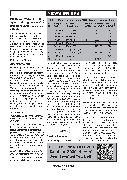
results are collated in Table 1.
From Table 1 it is evident that unfin-
ished fabric does not show any resis-
tance to water and allows the water
to pass easily while fabric treated with
Fabcoat-WB shows higher water re-
sistance as compared to unfinished
fabric. Also, it is seen that, higher the
add-on, better is the water resistance
of the fabric.
The other parameter which is tested
here is breathability. “Breathability” is
the measurement of the amount of
moisture vapor transported through
the fabric, into the atmosphere.
From the above results it is also clear
that higher the add-on of the polymer
lower is the breathability of the fabric
which can be seen in the above table.
The unfinished fabric shows higher
MVTR while the coated fabric shows
lower MVTR, this is because on coat-
ing, the pores of the fabrics get
blocked and thus does not allow the
air or moisture to pass through it.
85% Of Jobs That Will
Exist In 2030 Haven’t
Been Invented Yet: Dell
NCM-APRIL 2020
102MVTR (g/
m2/24hr)