                                EXECUTIVEPAGESPU Based Water Proofing Agent with High Water Column
Dr. Naresh M. Saraf - F.R.S.C., F.T.I., F.S.D.C., F.A.I.C. of Sarex, India
Abstract:
In current scenario of globalised trade, the need for specialty textiles are constantly growing,
leading to more technical developments and innovations of advance textiles for multi-
functionalities. The enhancement of textile performances according to the consumer's demands
includes a large array of properties with higher added value. To achieve this, the formulation
and understanding of polymeric surfaces have progressed tremendously, allowing to obtain
systems with well defined functionality. The use of coating for textiles, is one of the possible
ways to manufacture functional textile products.
Introduction:
Textile coating can be defined as the process of depositing a resin over a textile substrate, on one or two
sides. The different characteristics between the substrate and the coating product are combined to pro-
duce a new structure that acquires the best properties of each component. There are different procedures
for the coating of textiles and not all are suitable for all products or substrates. One of the procedures
most used is direct coating, which is based on the application of one or various layers of polyurethane,
PVC, acrylic resins, etc. paste, over the textile substrate, using a knife over air and knife over roll.
Polyurethane polymers are macromolecules made up of smaller, repeating units known as monomers.
Generally, they consist of a primary long-chain backbone molecule with attached side groups. PU coat-
ings are specifically preferred if abnormal impact and abrasion resistances are required, as well as for
various outdoor and marine uses (due to their good weather ability). PU coatings are used to produce
tents of different sizes, in upholstery and in waterproof protective clothing. Other examples include
luggage, footwear, glove and waterproof mattress covers, as well as imitation leather.
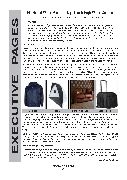
JacketsTentsFurnishing fabricLuggage fabric
Polyurethane resins are reaction products of a poly-isocyanate (materials containing more than one -NCO
group) with at least other species containing active hydrogen, often a polyol (materials containing more
than one -OH group).Due to these two different groups, polyurethanes (PUs) consisting of alternating soft
and hard segments are the most actively used polymers with a unique combination of a wide range of
physical and chemical properties such as abrasion resistance, water repellency, leather appearance, etc.
These properties provided by PU coating on textile substrates are very attractive in many textile applica-
tions.
Sarex Chemicals have also developed a special PU based coating i.e. Fabcoat-WB. It is ready to use
coating compound, recommended as a coating compound for outdoor fabrics like cordura, tents, luggage
fabrics etc. It forms a clear and tack free film with high water column. To obtain higher water column, two
coating of Fabcoat-WB is recommended.
Manufacturing of Polyurethane
Synthetic polymers, like polyurethane, are produced by reacting monomers in a reaction vessel. In order
to produce polyurethane, a step—also known as condensation—reaction is performed. In this type of
chemical reaction, the monomers that are present contain reacting end groups. Specifically, a di-isocyan-
ate (OCN-RNCO) is reacted with a diol (HO-R-OH).
Contd. On Page 102
NCM-APRIL 2020
36