                                The Comparison, Measuring & Labelling of Energy-efficient Textile Machinery
have a significant influence on the
overall energy requirements in many
production processes but are, however,
the responsibility of the textile
manufacturer.
The energy requirement and the
proportions of electrical and thermal
energy vary considerably between
individual production processes of the
textile manufacturing chain.
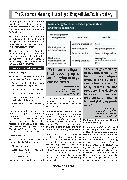
The following examples (see the
adjoining Table) selected from the
textile production chain explain the
various forms of primary energy in
terms of its application and importance
for the production process.
Example : The Drying Process
Electrical energy
The electrical energy required is mainly
composed of the following variables :
-Generating the air flow which
passes through the products
-Generation of the exhaust air flow
-Generation of the fresh air flow
-Drive for the main transport system
(such as perforated drum)
-Additional drives (reversing rollers,
etc.)
Here, generating the air flow which
passes through the products
represents the main energy
requirement. The pressure loss caused
by the products themselves can be
regarded as a constant. In essence,
the pressure loss (equivalent to the
consumption of electrical energy) is
determined by the internal air flow rate.
Thermal energy
The thermal energy required is mainly
composed of the following variables :
-Material warming
-Water evaporation exchange of
exhaust air/fresh air
-Heat loss on surfaces
In order to help the reader understand“With an intelligent
heat recovery up to
30 % drying energy
can be saved.”
Roland Hampel,
Managing Director,
A. Monforts Textil-maschinen
GmbH & Co. KG
the issues, the parameters which
determine the energy efficiency of
the machines presented as examples
are explained here.
The thermal energy needed for heating
the material in a drying process
depends mainly on the fibre-specific
properties (specific heat capacity) of
the product and can be regarded as a
constant. The amount of water to be
evaporated in the product is the major
determinant of the energy requirement.
The greatest impact on energy demand
results from the exhaust air that is
removed from the system and which
removes the water evaporated during
the drying process. Fresh air is
introduced into the system in order to
maintain a constant air balance within
the system boundaries. Heat losses
arising on the surfaces depend on the
design of the insulation and existing
thermal bridges.
NCM-APRIL 2020
55“The energy efficiency
of equipment can only
be compared objec-
tively if energy con-
sumption is specifi-
cally related to the
products. The decisive
factor is how much en-
ergy per kg of material
is used (kWh/kg prod-
uct).”
Axel Pieper,
Managing Director/CEO,
BRÜCKNER Trocken-
technik GmbH & Co. KG
Features of an energy-efficient
machinery concept
In terms of electrical energy, a
machine design with an optimized flow
profile and minimal pressure loss is the
essential feature. With regard to thermal
energy, this applies to the exhaust and
fresh air management. The energy
balance can be significantly influenced
by a low exhaust air temperature and
high exhaust air humidity – by logically
controlling the air flow in relation to the
maximum allowable moisture content.
Heat recovery to heat the fresh air also
reduces the energy demand. Thus, air/
air heat exchangers, for example, can