                                INTERNATIONAL BUSINESS PAGES
Therefore, EURATEX is asking the
European Commission to focus on the
following points:
1. 99% of the textile and apparel in-
dustry is composed by SMEs. The
EU needs to take into consideration
their specificities. In particular,
SMEs lack fund to upscale their
products and solutions, plus they
need a legislative framework which
is not burdensome. We ask the EU
to remove barriers, not create new
ones.plan can be the starting point for a new structural dialogue with the EU and
partners of the value chain. All the actors need to agree on what has to be
changed and how to unleash circular textile products”.
March 4, 2020
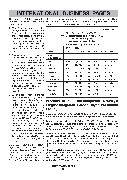
Major Shippers Report - Top Ten
U.S. General Imports (Million Dollars; M $)
Textiles and Apparel
(January - January 2020)
YEAR TO DATE (January-January)
20192020
9,9858,954 M $,dn-1031 M $or -10.33%
China3,6202,473 M $,dn-1147 M $or -31.68%
India721720 M $,dn-1 M $or -0.18%
Vietnam1,3381,394 M $,up57 M $or 4.25%
Pakistan273261 M $,dn-12 M $or -4.34%
Mexico340304 M $,dn-36 M $or -10.57%
Bangladesh549637 M $,up88 M $or 16.09%
Korea, South9080 M $,dn-9 M $or -10.30%
Indonesia430445 M $,up15 M $or 3.48%World
2. Companies need a territory that
can deal with the whole circularity
process. A company, which produc-
es textiles by recycling used
clothes or other fibers, should have
a textile recycling facility in the vi-
cinity, not 250km away. We, there-
fore, welcome the proposal of the
European Commission to provide
guidance to achieve high levels of
separate collection of textile waste
by 2025. It must be done in a well-
organized manner, so to avoid tons
of waste textile waiting to be pro-
cessed.TOP TEN
COUNTRIES:
Cambodia254319 M $,up65 M $or 25.61%
3. Green Public Procurement will
increase demand allowing business
to invest in circularity. In 2015, pub-
lic procurement accounted for
13.1% of the GDP in the EU, this
means that almost Euro 1.923 bln
were spent by public bodies pur-
chasing goods or services. That is
a formidable leverage which Mem-
ber States can use to boost closed-
loop productions, promote scale
economies which lower costs and
proactively drive changes. Authori-
ties can then choose high quality
and durable products, reward low-
impact manufacturing processes,
and favour products designed with
recycled or biobased/biodegradable
materials.Honduras154155 M $,up2M$or 1.07%
EURATEX looks forward to the upcom-
ing initiatives announced by the EC in
the Circular Economy Action Plan, as
it wants to be part of the development
of polices, making circularity an effi-
cient reality. According to EURATEX
Director General Dirk Vantyghem “thisPresident of Indonesia Inaugurates Country’s
Largest Integrated Viscose Rayon Production
Facility
Investment of Rp. 15 trillion (USD1,1 billion) in facility; Supports develop-
ment of national textile industry and ‘Making Indonesia 4.0’ roadmap
Pangkalan Kerinci, Indonesia – 21 February 2020: The President of Indonesia,
Joko Widodo, today inaugurated Indonesia’s largest integrated viscose rayon
production facility, injecting a boost for the country’s textile sector and the
Indonesian Government’s industrial 4.0 development strategy.
The new Asia Pacific Rayon (APR) facility is located in the same production
complex as APRIL Group in Pangkalan Kerinci, Riau province, Sumatra. This
co-location allows integrated operations where renewable plantation pulp sup-
ply from APRIL feeds directly to APR for viscose rayon production. The new
operation represents a total investment of approximately Rp.15 trillion (USD1.1
billion).
The APR facility has an annual production capacity of 240,000 tons. The inau-
guration ceremony included the signing of a plaque by President Widodo and
the symbolic sealing by the President of an export container with 10,190 tons
of viscose rayon fibre for shipment to Turkey, one of APR’s key export markets,
and another 12,000 tons to Central Java.
NCM-MARCH 2020
68