                                The World and United States Cotton Outlook
James Johnson, Kent Lanclos, Stephen MacDonald, Leslie Meyer, and Graham Soley
United States Department of Agriculture
Introduction
The U.S. Department of Agriculture’s
(USDA’s) first 2020/21 world cotton pro-
jections anticipate that consumption
will exceed production, reducing world
stocks by 2.5 million bales. World cot-
ton production is expected to fall 2.3
percent, with area declining in a num-
ber of countries. Global consumption
is expected to resume growing, with
the projected rate of expansion at its
long-run average. It is expected that
China will resume gradually expanding
imports following years of significant
import access limitations to facilitate
disposal of surplus government-held
stocks. The A Index is forecast to rise
3 cents to 79 cents per pound due to
projected lower stocks outside of
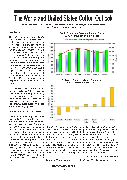
China.World Production, Consumption, and Prices
2015/16 through 2020/21 projection
Estimated Changes in World Production,
2019/20 compared with 2018/19
U.S. 2020/21 cotton production is ex-
pected to decline to 19.5 million bales,
based on a reduction in planted area,
and a second year of close to median
abandonment. Domestic mill use and
exports are projected unchanged from
their 2019/20 levels, but ending stocks
are projected slightly lower.
World Cotton Production, 2019/20
Global 2019/20 cotton production is
expected 2.3 percent higher from the
previous year to 121.3 million bales,
as increases in the United States and
India more than offset lower output in
Australia and Pakistan. The United
States saw a 9.4-percent increase with
the largest area harvested in thirteen
years, and higher production in the
Delta and Southeast regions. India was
the world’s largest producer as record
area harvested helped drive production
to its highest in five years at 29.5 mil-
lion bales. In contrast, Australia wit-
nessed the most significant downward
shock in 2019/20, as severe drought
drove production to its lowest in twelve
years.The world’s second largest producer,
China, witnessed area harvested and
production down slightly from 2018/19
at 27.3 million bales. Lower yields in
Xinjiang mostly led to the yearover-
year decline due to unfavorable
weather. China’s 2019/20 harvested
area is estimated at 3.45 million hect-
ares, down marginally from the previ-
ous year, while yields fell below the
previous two years at 1,720 kg/hect-
are.at 29.5 million bales, up more than 14
percent from the preceding year on
higher area and yields. As a result, In-
dia surpassed China as the world’s larg-
est producer. Harvested area is esti-
mated at 13.0 million hectares, up 3.2
percent despite some reports of pink
bollworm infestations and late-season
monsoon rainfall. India’s 2019/20 yield
is estimated at 494 kg/hectare, also
above the previous season.
India’s 2019/20 production is estimatedChina’s 2019/20 consumption is pro-
NCM-MARCH 2020
242019/20 China Supply and Demand