                                The World and United States Cotton Outlook
USDA Projections for China, 2020/
21
USDA’s China outlook is based on the
policies outlined in the Appendix. Im-
ports and consumption are projected
to increase. Production is forecast
down slightly while stocks are expected
to fall for the sixth consecutive year in
2020/21. China’s production is pro-
jected to decrease slightly again, as
declines in the east again more than
offset any gains in Xinjiang production.
China’s consumption is projected to
increase slightly due to recovery from
the impacts of the COVID-19 outbreak
and reduced U.S. – China trade ten-
sions.
China’s State Reserve is expected to
both buy and sell cotton during the
2020/21 season. Programs to purchase
both foreign cotton and domestic cot-
ton similar to the programs for the 2019/
20 season are expected in 2020/21 as
part of the stated rotation policy for the
State Reserve. Likewise, sales from
the State Reserve are expected in the
spring of 2021. Reserve stocks at the
end of 2020/21 are expected to be
roughly the same as the beginning
level.
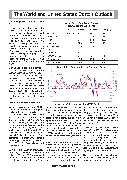
World Cotton Consumption, 2020/21
World cotton consumption in 2020/21
is expected to resume growing after
declining for two consecutive years.
After declining 2 percent in 2018/19 and
1 percent in 2019/20, consumption is
expected to grow nearly 1.7 percent in
2020/21, returning to the long-run av-
erage growth rate. According to the
International Monetary Fund (IMF),
world income growth in calendar 2019
was its weakest since the Global Fi-
nancial Crisis a decade before. This,
combined with uncertainty regarding
textile supply chains during 2019, has
had a negative effect on clothing and
cotton consumption.
With the IMF’s January 2020 forecasts
indicating that global income gains in
calendar 2020 and 2021 are expected
to rebound to close to the median
growth rate realized before 2019, cot-China Cotton Supply and Demand
2019/20 est. and 2020/21 proj.
Unit2019/202020/21Change (%)
Beg. Stocks
ProductionMil. bales
"35.7
27.333.7
27.0-5.4
-0.9
Imports
Total supply"
"8.5
71.410.0
70.717.6
-0.9
Consumption
Exports"
"37.5
0.238.5
0.22.7
-14.3
Total use
Ending stocks"
"37.7
33.738.7
32.12.6
-4.9
Reserve stocks
Stocks-to-use“
%10.5
89.610.5
83.00.0
-7.4
World Cotton Consumption and Economic Growth
Sources: USDA and International Monetary Fund.
ton consumption is likely to grow. The
Phase One trade agreement between
China and the United States helped
reduce the uncertainty that weighed on
global income gains, but since the
agreement the spread of COVID-19
across large portions of China and to
other countries has added additional
uncertainty. This outlook assumes that
the negative economic impact of the
COVID-19 outbreak is relatively small
and affects only marketing year 2019/
20.
China’s 1-million-bale expected con-
sumption gain in 2020/21 equals half
of the 2 million bales expected globally.
With 38.5 million bales of cotton con-
sumption, China’s share of global ac-
tivity is expected to be about un-
changed. China has been the world’s
largest cotton consuming country
NCM-MARCH 2020
29since the mid-1960s, and while its
share of world cotton spinning fell
sharply after 2009, it has stabilized in
recent years. While higher than in 2019/
20, China’s projected 2020/21 cotton
consumption would be its second low-
est since 2015/16.
The second and third largest consum-
ing countries - India and Pakistan - saw
rebounds in their consumption in 2019/
20 and are expected to continue grow-
ing in 2020/21. Bangladesh and Viet-
nam have had setbacks to their con-
sumption in recent years, and are ex-
pected to resume growth in 2020/21,
albeit at rates far below the stellar gains
regularly achieved before 2018/19.
Cotton continues to lose share to poly-
ester in world textile markets, but the
annual losses in share have been rela-