                                Water and Oil Repellent Finishing of Textiles by UV Curing
factor are displayed on the x-axis, while
a separate line for each level of anoth-
er factor is drawn. Parallel lines in an
interaction plot indicate no interaction,
while the greater the difference in slope
between the lines, the higher the de-
gree of interaction. However, the inter-
action plot does not alert if the inter-
action is statistically significant.
In Figure S2, the worst behavior was
shown by PM fabric, but this was im-
proved lowering the Oleophobol con-
centration or increasing the irradiance.
Lowering the irradiance, CA on both
COT and PM decrease, while on VIS it
is the contrary. In general, the best re-
sults were obtained by applying a me-
dium product concentration on COT
under medium–high irradiance.
For what concerns the Interaction Plot
for oil repellency (Figure S3 in Supple-
mentary Material), similar results were
found: medium product concentration
was confirmed as optimal, but the ef-
fect of the irradiance on the “difficult”
samples, that is PM with higher prod-
uct concentration, was more influent
with respect to water repellency.
On the other hand, a Main Effects Plot
displays the means for each group
within a categorical variable. A line
connects the points for each variable.
When the line is horizontal (parallel to
the x-axis), there is no main effect
present and the response mean is the
same across all factor levels. When the
line is not horizontal, there is a main
effect present and the response mean
is not the same across all factor lev-
els. The steeper the slope of the line,
the greater the magnitude of the main
effect.
Although this plot can be used to dis-
play the effects, the appropriate ANO-
VA test must be performed and the
statistical significance of the effects
evaluated.
The Main effect plots for CA with both
water and oil (Figures S4 and S5, re-
spectively in Supplementary Materials)
show that the optimal conditions to
obtain the best results in terms of both
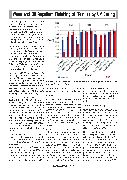
water and oil repellency on white COTFigure 7: Water and oil CA on each fabric vs. finish type with 50 g/L Ole-
ophobol concentration.
fabric is the treatment with medium
product concentration and irradiance.
Pymasil
For Pymasil-treated samples, only the
water contact angle was considered for
discussion since oil repellency was not
conferred by such finishing agent. Wa-
ter CA measured on Pymasil-treated
samples showed a wider dispersion
compared to Oleophobol. In particular,
o
of 81 values, 16 are lower than 160
o
and 3 are lower than 150 , which is con-
sidered the lower limit for superhydro-
phobicity.
ANOVA analysis revealed the type of
substrate as the most influencing pa-
rameter, while the effect of product
concentration and irradiance were neg-
ligible. The effect, as reported in Inter-
action Plot and Main effect plot (Fig-
ures S6 and S7, respectively in Sup-
plementary Materials) was opposite
compared to Oleophobol results: High-
er water repellency was in fact obtained
on PM while VIS gave the worst re-
sults. In detail, PM and VIS show op-
posite behaviors: On the first, higher
NCM-APRIL 2020
72CA values are obtained with lower prod-
uct concentration and the effect of the
irradiance is negligible, while on VIS
the best results are achieved with high-
er product concentration and higher ir-
radiance.
Thermal vs. UV Curing
Considering the drop absorption times,
no substantial differences ascribable
to the finishing process can be noted
for Oleophobol. On the other hand,
comparing the results on Pymasil-treat-
ed samples, UV curing improved the
water absorption more than twice with
respect to thermal curing.
Considering CA values on each fab-
ric, the comparison between the results
with the highest concentration of Ole-
ophobol is reported in Figure 7. It is
evident that UV irradiation on PM un-
der medium and higher irradiance im-
proves both water and oil repellency
of treated fabrics compared to thermal
process, while on VIS the results are
improved even at lower irradiance. In-
stead, thermal and UV curing yield
practically the same results on COT.