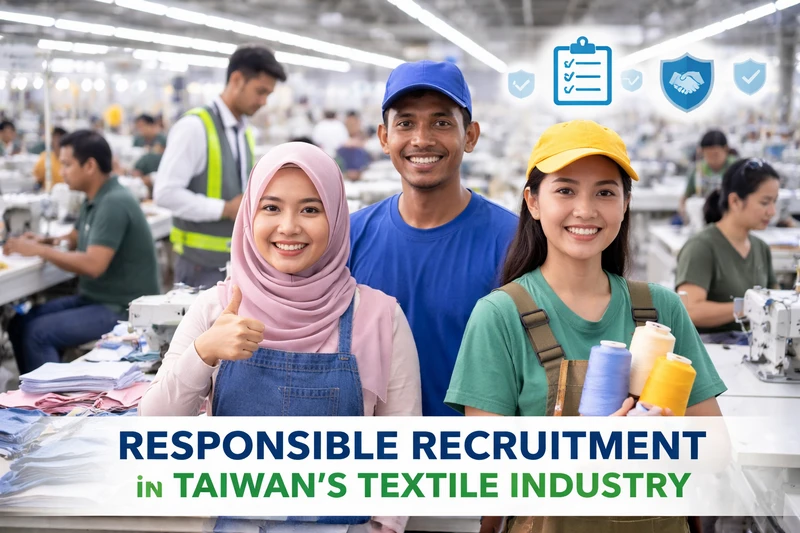
Taiwan’s textile industry strengthening ethical supply chains and protecting migrant workers
Taiwan’s textile industry has taken a significant and timely step toward strengthening ethical supply chains and protecting migrant workers with the formal release of its Statement on Responsible Recruitment and Employment. Issued on December 10, 2025, by the Taiwan Textile Federation, the statement marks a clear industry-wide commitment to align recruitment and employment practices with international human rights expectations and evolving global buyer requirements .
At the heart of this initiative is a principle that has rapidly become a global benchmark for ethical hiring: the employer pays principle. Under this approach, textile mills commit to ensuring that migrant workers do not pay any fees to secure their jobs. Recruitment, hiring, training, documentation, travel, medical checks, and associated administrative expenses are recognized as normal business costs and must be fully borne by employers. The Federation has strongly encouraged all member mills to adopt this principle with an implementation target of January 1, 2026, signalling that responsible recruitment is no longer optional, but a core element of sustainable textile manufacturing in Taiwan .
The guidelines draw heavily on standards set by the International Labor Organization, particularly its definition of fair recruitment and its clear stance that undisclosed, inflated, or illicit recruitment costs are never legitimate. Practices such as bribes, kickbacks, bonds, or informal payments demanded anywhere in the recruitment chain are explicitly rejected. The Federation has underlined that paying such fees not only perpetuates corruption in labor-sending countries but also exposes international buyers to serious legal risks under frameworks such as the United Nations Convention against Corruption and the U.S. Foreign Corrupt Practices Act .
Beyond setting principles, the guidelines move decisively into implementation. Textile mills are encouraged to develop internal policies and procedures that clearly explain how responsible recruitment will be applied in practice and communicated both internally and externally. Where labor brokers are used, employers are expected to negotiate transparently, pay brokers directly for legitimate services, and ensure that no costs are passed on to workers. Importantly, migrant workers must be informed of the key terms of their employment—wages, deductions, accommodation, and working conditions—in a language they understand before leaving their home country .
Recognizing that historical recruitment practices have often left workers with debt, the guidelines place strong emphasis on reimbursement. Employers are expected to interview workers upon arrival to identify any fees paid during recruitment and to reimburse those costs promptly. This obligation applies not only to new hires but also to current workers who may have been recruited before a no-fees policy was adopted. Even where documentation is missing, employers are encouraged to use best-practice estimates based on nationality and recruitment corridor norms to ensure workers are made whole. While the employer retains responsibility, the guidelines also open the door for buyers to share the financial burden of reimbursement, acknowledging the shared responsibility embedded in global supply chains .
The scope of responsibility extends well beyond recruitment costs. The employment section of the guidelines highlights the particular vulnerabilities faced by migrant workers and sets clear expectations for ethical treatment. These include ensuring workers retain control of their passports and travel documents, enjoy freedom of movement, live in decent conditions, and are not subjected to excessive or involuntary overtime. Workers must also have access to grievance mechanisms, professional medical care, and the right to form or join unions in accordance with Taiwanese law .
Even at the end of employment, the Federation’s guidance remains explicit. Employers are expected to fully fund return travel costs when contracts conclude and to handle early terminations strictly in line with Taiwan’s Labor Standards Act. Transparency around notice periods and termination costs is emphasized as a safeguard against exploitation and misunderstanding .
To support industry-wide adoption, the Taiwan Textile Federation has committed to working closely with brands, customers, and international organizations to provide training and documentation assistance. This collaborative approach is particularly important as Taiwan’s Ministry of Labor prepares to release new corporate action plan guidelines in January 2026 aimed at preventing and eliminating forced labor. These forthcoming government guidelines, also aligned with ILO indicators, are expected to give companies a consistent national framework for self-assessment and risk mitigation, reinforcing the Federation’s efforts rather than duplicating them .
Taken together, this initiative positions Taiwan’s textile sector as a proactive participant in the global shift toward ethical sourcing. For international buyers, it offers greater legal certainty and reputational assurance. For mills, it provides a clear operational roadmap. And most importantly, for migrant workers, it represents a meaningful move toward dignity, transparency, and freedom from recruitment-related debt. As global scrutiny of labor practices intensifies, Taiwan’s approach sends a clear message: responsible recruitment is not just a compliance requirement, but a foundation for long-term industry resilience.