
 Reduction in Hank Yarn Packing Obligation from 30% to 20%
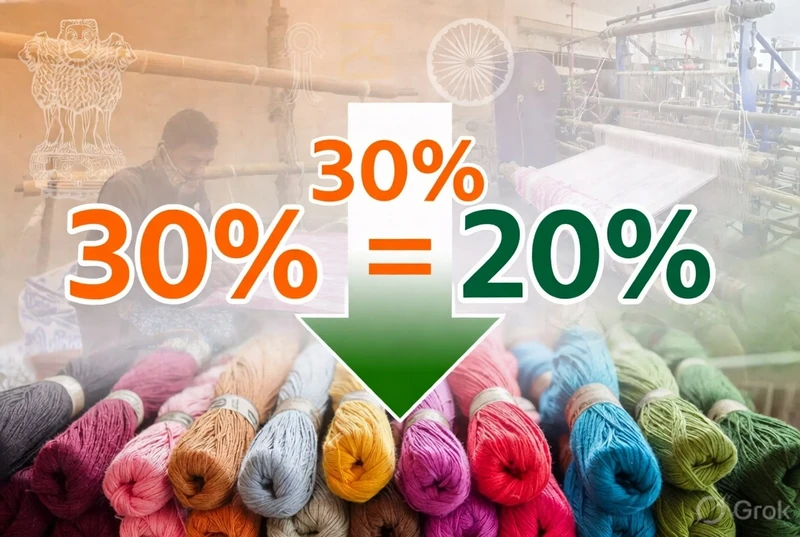 Reduction in Hank Yarn Packing Obligation from 30% to 20%
The Ministry of Textiles has notified a reduction in the mandatory hank yarn packing obligation for yarn producers from 30% to 20% of total yarn packed for domestic consumption. The revised norms aim to balance the needs of the handloom sector with operational flexibility for the spinning industry.
Issued by the Office of the Textile Commissioner under the Textiles (Development and Regulation) Order, 2001, the new notification supersedes the earlier order dated 17.04.2003 (as amended). It comes into force with effect from 1st July 2026 and shall remain valid until 30th June 2029.
As per the notification, every producer of yarn who packs yarn for domestic consumption shall pack not less than 20% (twenty percent) of the total yarn in hank form during each quarterly period. Of this, not less than 80% must be in counts of 80s and below. The order maintains provisions for captive consumption, transfers of obligation between mills, external reeling arrangements, carry-forward of minor shortfalls/excesses, and exemptions for relief undertakings.
Producers are required to submit quarterly hank yarn packing returns online through the portal www.txcindia.gov.in by the stipulated deadlines. Detailed formats for returns, transfer applications, and certificates have been prescribed in the annexures to the notification.
This revision is expected to provide relief to the spinning sector while continuing to ensure adequate availability of hank yarn for the handloom industry, which remains a vital source of livelihood in rural and semi-rural areas.
Hank Yarn Packing ObligationHank Yarn Packing Obligation is a mandatory requirement placed by the Indian government on all spinning mills to support the country’s traditional handloom industry. Under this policy, every producer of cotton yarn must pack a certain minimum percentage of their total yarn meant for domestic sale in the form of “hank yarn” — which is yarn wound into large, loose loops or bundles rather than the more common compact cone or cheese form. Handloom weavers across rural India prefer hank yarn because it is easier to handle and use directly on traditional handlooms. As per the latest notification issued on 15th June 2026 by the Office of the Textile Commissioner, this obligation has been reduced from the earlier 30% to 20% of the total yarn packed for domestic consumption, effective from 1st July 2026. Out of this 20%, at least 80% must be in coarser counts (80s and below), which are most suitable for handloom production. The policy ensures that adequate quantities of hank yarn remain available at reasonable prices for handloom weavers, who form a vital part of rural livelihoods. Mills that do not have their own reeling facilities can get the yarn converted into hanks through approved third-party reelers or transfer their obligation to other mills that have produced surplus hank yarn. The system also allows limited carry-forward of shortfalls or excesses to the next quarter and provides exemptions for mills declared as relief undertakings. In essence, the Hank Yarn Packing Obligation is a regulatory mechanism designed to protect and sustain the handloom sector by compelling the organised spinning industry to contribute a share of production in the form most needed by traditional weavers, while the recent reduction offers some relief to the spinning mills. Mills are required to submit detailed quarterly returns online to ensure compliance with this directive. |
About the Office of the Textile Commissioner
The Office of the Textile Commissioner, under the Ministry of Textiles, Government of India, is responsible for the implementation of various regulatory and developmental measures for the orderly growth of the textile industry.