
TEXPROCIL Export Awards 2023-2024:
Celebrating Excellence and Charting the Future of India’s Cotton Textile Exports
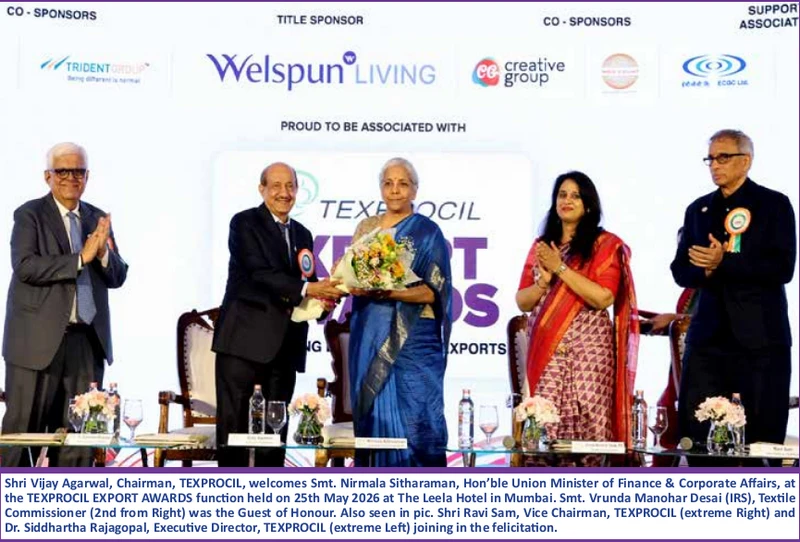
On May 25, 2026, at the elegant Leela Hotel in Mumbai, the Cotton Textiles Export Promotion Council (TEXPROCIL) hosted its Annual Export Awards Function to honor the outstanding achievements of its member exporters for the fiscal year 2023-2024. As India’s premier export promotion council for cotton textiles—established in 1954—TEXPROCIL has long played a pivotal role in boosting the sector’s global footprint. The event brought together industry leaders, government dignitaries, and stakeholders to recognize top performers while addressing broader challenges and opportunities in the textile ecosystem.
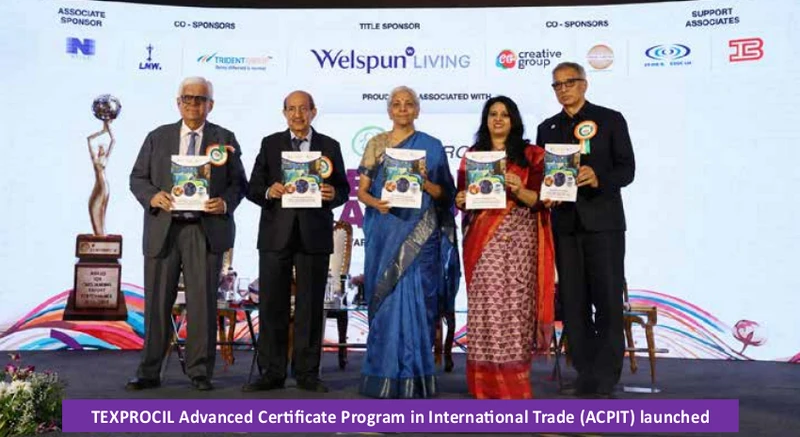
The occasion was graced by the Chief Guest, Smt. Nirmala Sitharaman, Hon’ble Union Minister of Finance and Corporate Affairs, who distributed the awards and formally launched TEXPROCIL’s new Advanced Certificate Program in International Trade (ACPIT). Also present was Smt. Vrunda Desai, the Textile Commissioner, underscoring the strong government-industry collaboration. In his welcome address, TEXPROCIL Chairman Shri Vijay Agarwal highlighted the council’s nearly 2,000 members, who contribute exports valued at around US$ 11 billion. He emphasized the sector’s massive employment footprint—supporting approximately 35 million people directly and indirectly—and TEXPROCIL’s initiatives to promote the Indian cotton brand “Kasturi Cotton” through branding, certification, and traceability.
Shri Agarwal praised the Government of India’s supportive measures amid global disruptions since 2020, including the Aatma Nirbhar Bharat package, ECLGS, MSME initiatives, and trade facilitation efforts. He welcomed newer policies such as the Export Promotion Mission from the Union Budget 2025–26 and the TEEM Scheme and Tex Eco Initiative from the 2026–27 Budget. These, he noted, would enhance competitiveness, sustainability, modernization, and job creation. He also pointed to opportunities from recent Free Trade Agreements while calling for continued focus on raw material availability at competitive prices, tax remission, affordable finance, and logistics improvements to meet ambitious targets: a US$ 350 billion textile market with US$ 100 billion in exports by 2030.
Smt. Vrunda Desai echoed these sentiments in her remarks, thanking the Finance Minister for budget announcements like the Textile Expansion and Employment Scheme (TEEM), National Fibre Scheme, Tex-Eco Initiative, and Samarth 2.0. She spotlighted the Ministry of Textiles’ District-led Textiles Transformation initiative, aimed at turning high-potential districts into global manufacturing and export hubs by leveraging local strengths, skills, MSME clusters, and traditional capabilities. Other key government programs mentioned included PM MITRA Parks, the Production Linked Incentive (PLI) Scheme, the National Technical Textiles Mission, and efforts in sustainability, traceability, quality enhancement, and modernization.
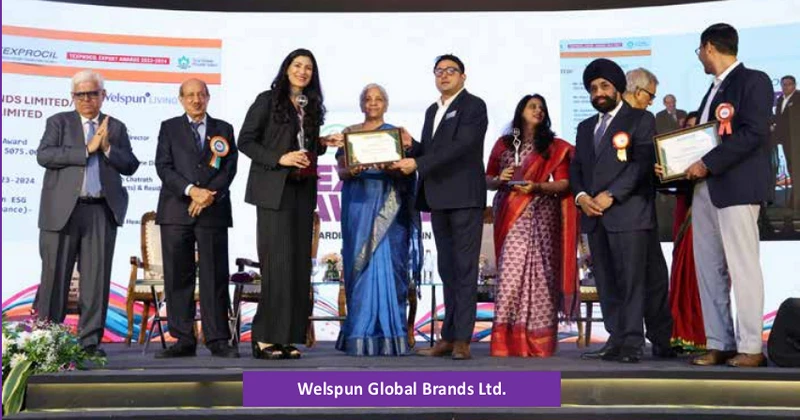
The highlight of the evening was the launch of the ACPIT, a structured certification program developed by TEXPROCIL and aligned with government schemes to build export capabilities, particularly for MSMEs. Smt. Sitharaman lauded the industry-driven nature of the program, noting that certifications designed and delivered by the sector itself carry greater relevance and impact compared to generic government or academic offerings. She commended Indian exporters for their resilience as the world’s largest exporter of cotton yarn, despite headwinds like geopolitical tensions, protectionism, tariffs, and disruptions.
In her address, the Finance Minister outlined future challenges: geopolitical fragmentation, non-tariff barriers, global competition, sustainability demands, and the rise of AI and automation. She stressed the growing buyer preferences for traceability, organic and recycled fibers, lower carbon footprints, and ethical labor practices. Indian exporters adapting proactively would gain a significant edge. Looking toward Viksit Bharat @2047, she reiterated targets of US$100 billion in textile exports and US$250 billion in production by 2030, positioning India as a leader in sustainable textiles. India’s natural strengths—abundant cotton, silk, handloom traditions, natural dyes, and artisanal crafts—align perfectly with premium global demand.
Smt. Sitharaman emphasized building robust certification systems, traceability infrastructure, and branding platforms. She acknowledged ongoing pressures from climate change and technology but framed them as opportunities. Her metaphorical conclusion resonated deeply: just as a cloth holds together through the proper tension of every thread, India’s textile sector thrives when farmers, spinners, weavers, processors, designers, exporters, policymakers, and institutions like TEXPROCIL work in harmony. “India has always been a land of weavers,” she said, “and we can now weave the future of global trade.” Mr. Ravi Sam, Vice Chairman of TEXPROCIL, proposed the Vote of Thanks.
Recognizing Excellence: The Award Winners
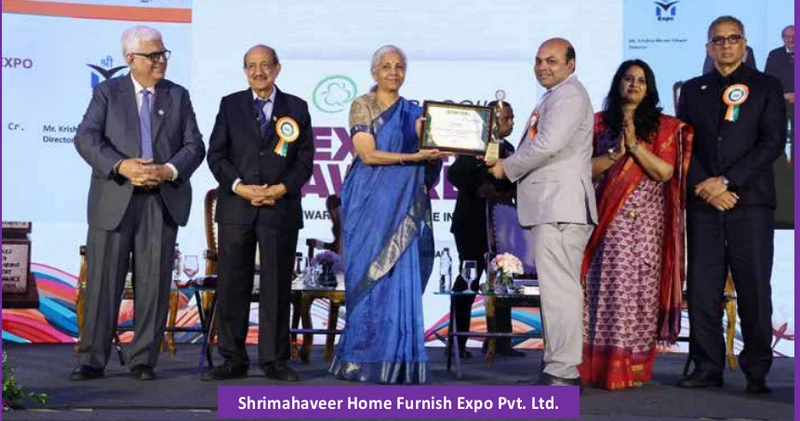
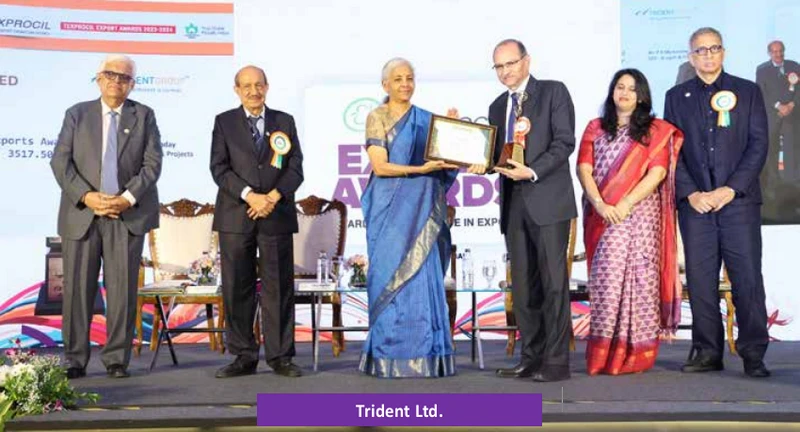
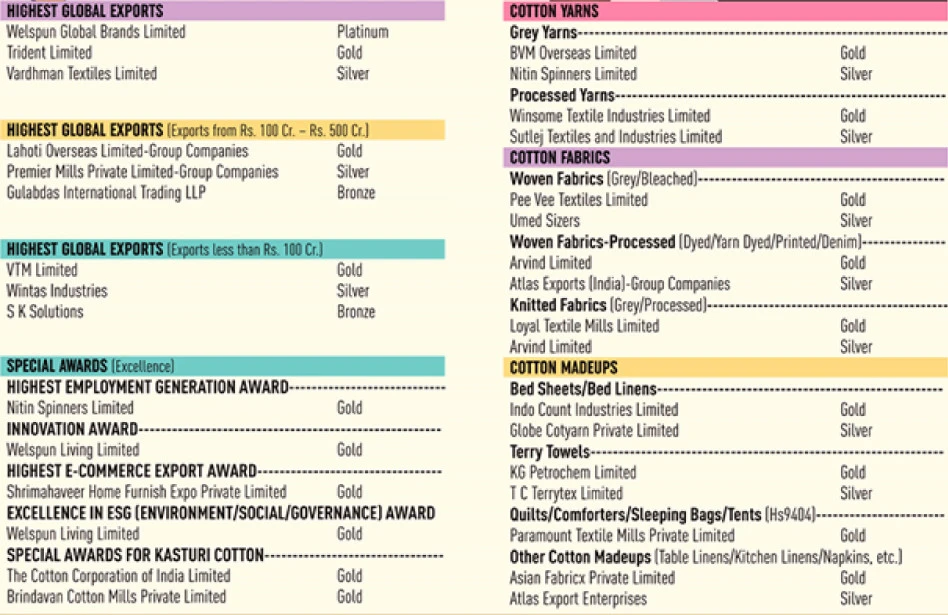
The core of the event was the presentation of awards across multiple categories, celebrating export performance, employment generation, innovation, e-commerce, and ESG (Environment, Social, Governance) excellence. Top honors for Highest Global Exports went to:
– Platinum Trophy: Welspun Global Brands Limited
– Gold: Trident Limited
– Silver: Vardhman Textiles Limited
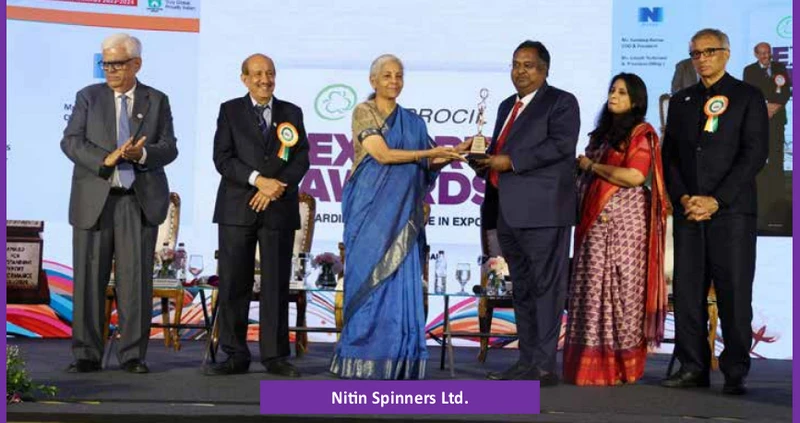
Other notable winners included companies like Indo Count Industries (strong in cotton made-ups, particularly bed linen), Nitin Spinners (employment generation), Welspun Living Limited (innovation and ESG), and many more in yarns, fabrics, and made-ups categories. Special recognition was also given for Kasturi Cotton initiatives.
These awards not only honor past performance but also inspire the industry to aim higher amid evolving global standards.
Broader Context and Outlook
The 2023-2024 awards come at a transformative time for India’s textile sector, which contributes significantly to GDP, employment, and exports (India ranks as the sixth-largest textile exporter globally, with exports around USD 33.5 billion in 2025-26). Government reforms since 2014—GST, ATUFS, PM MITRA Parks, and skilling programs—have laid a strong foundation. TEXPROCIL’s focus on capacity building, stakeholder engagement, digital platforms, and FTAs positions its members well for growth.
Challenges remain, including raw material volatility, sustainability compliance, and competition. Yet, with initiatives like ACPIT, Kasturi Cotton, and cluster development, the sector is poised for modernization and expansion. The event at The Leela Hotel served as both a celebration of resilience and a call to collective action—reminding all stakeholders that India’s textile future depends on every “thread” pulling its weight toward global leadership in quality, sustainability, and innovation.
This memorable gathering reinforced TEXPROCIL’s enduring role as a catalyst for the cotton textile industry, fostering pride in achievements while charting a collaborative path forward.