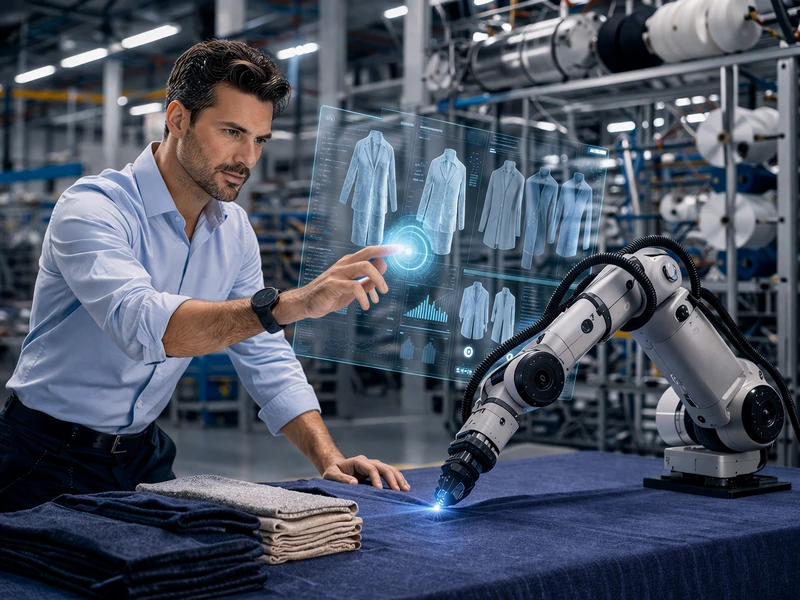
As automation reshapes textile manufacturing, the industry is entering a phase in which human expertise and intelligent machines are designed to work side by side rather than in competition.
Industry 5.0 and the Future of Textile Manufacturing
From the punched cards of the Jacquard loom to the sensor-driven spinning mills of today, textile manufacturing has always evolved in step with its machines — but the current shift toward Industry 5.0 is putting the human worker, not the technology itself, back at the centre of the story.
Textile manufacturing is entering one of the most consequential phases of transformation in its long history. Across spinning, weaving, knitting and finishing operations, digital technologies, artificial intelligence and connected machinery are reshaping not only how fabric is made but who makes it, and how. Rather than the fully automated, worker-free factory floor that dominated earlier predictions, the industry appears to be converging on something more nuanced: a production model in which advanced machinery and human expertise operate side by side, each compensating for the other’s limitations.
This emerging model reflects the broader industrial philosophy known as Industry 5.0, a concept first articulated by the European Commission’s Directorate-General for Research and Innovation in a January 2021 policy paper. Where the preceding paradigm, Industry 4.0, concentrated almost exclusively on digitalisation, connectivity and operational efficiency, Industry 5.0 was deliberately framed as something broader. It rests on three interlocking pillars — human-centricity, resilience and sustainability — and it explicitly repositions the wellbeing of the industrial worker at the centre of the production process, rather than treating labour as a variable to be optimised away. For an industry as labour-intensive and globally dispersed as textiles, that reframing carries particular weight.
Defining the shift: from advanced manufacturing to advanced automation
To make sense of where the textile sector is heading, it helps to separate two terms that are frequently used interchangeably but describe different things. Advanced manufacturing refers to the broad application of sensors, data analytics, artificial intelligence, robotics and connected equipment to improve productivity, quality, agility and sustainability across an operation. In a textile mill, this means spinning, weaving, knitting and finishing machines that continuously exchange data with one another, allowing performance to be optimised not machine by machine but across the entire production floor.
Advanced automation sits inside that broader category. It refers specifically to the use of intelligent machines, robotics and software to carry out tasks with minimal human intervention, streamlining workflows and enabling production decisions to be made on the basis of real-time data rather than fixed schedules or manual inspection. The distinction matters because much of the anxiety surrounding textile technology conflates the two: automation is often assumed to mean the wholesale removal of people from the process, when in practice the more advanced and more valuable systems tend to depend on skilled human oversight to function well at all.
A two-century echo: from the Jacquard loom to connected production
The tension between technological promise and workforce anxiety is not a new feature of the textile industry — it is arguably the industry’s oldest recurring story. More than two centuries ago, the introduction of the Jacquard loom triggered a transformation that mirrors today’s digital shift in striking detail. Patterns were first drafted on gridded paper, then translated into sequences of punched cards, each hole dictating a specific thread movement. Chained together and fed into the loom, these cards allowed intricate woven designs to be reproduced with a consistency and speed that no individual weaver could match by hand.
When the technology reached Britain in the 1820s, tasks that had once demanded years of apprenticeship could suddenly be performed far more cheaply and quickly, delivering a clear commercial advantage to mill owners. The social response was severe: the rapid mechanisation of British textile production fed directly into the rise of the Luddite movement, whose displaced workers attacked mills and destroyed machinery out of genuine economic fear. Those fears, in hindsight, were not baseless — but they told only part of the story. Alongside the disruption, a new class of engineers, technicians and machine specialists emerged, gradually raising the technical sophistication of the entire trade. It is a pattern textile manufacturing has now repeated several times over, through mechanised spinning, electrification and computer-integrated manufacturing, and it appears to be repeating again today.
Worth remembering: the punched-card logic behind the Jacquard loom is widely credited as a direct conceptual ancestor of modern computing. The binary, on-off structure of interlacing yarns is thought to have influenced Charles Babbage’s design for the Analytical Engine — meaning the textile industry’s fingerprints are, in a very real sense, on the origin story of computer science itself.
What Industry 5.0 actually asks of a factory
The European Commission’s original framing of Industry 5.0 was written for manufacturing broadly, not for textiles specifically, but its three pillars map onto the sector unusually well. Human-centricity asks that new technology be evaluated first by what it does for the people operating it, rather than purely by its efficiency gains — a meaningful reframing for an industry historically associated with repetitive, physically demanding and sometimes hazardous work. Resilience asks that production systems be designed to withstand shocks, whether those come from volatile raw material costs, energy price swings or fractured supply chains, rather than being optimised solely for lowest-cost, highest-throughput operation under stable conditions. Sustainability asks that resource use — water, energy, fibre — be treated as a core design constraint rather than an afterthought addressed through offsets once production is complete.
None of these pillars is achievable through automation alone. Each depends on a workforce capable of interpreting data, adjusting processes and exercising judgment that current AI and robotics systems still cannot replicate reliably on their own — which is precisely the argument Industry 5.0 proponents make for keeping skilled operators, not fewer of them, at the centre of the modern mill.
What is changing on the factory floor
The physical experience of textile work has already shifted considerably. Operators were historically required to manually handle heavy warp beams, monitor several machines simultaneously and intervene constantly to correct faults or replace broken yarns — work that demanded intense concentration and physical endurance, frequently under difficult environmental conditions. Automated handling systems now assist with the movement and positioning of heavy beams and fabric rolls, reducing both the physical burden and the injury risk associated with that work.
Sensor technologies now continuously track yarn tension, fabric quality and machine performance, allowing systems to correct faults automatically or flag operators only when genuine intervention is required, rather than demanding constant manual monitoring. Machine layouts, touchscreen interfaces and simplified control architectures have also become more ergonomic, reducing operator fatigue, while predictive maintenance and modular components mean that servicing — once a time-consuming process of dismantling equipment — can increasingly be planned in advance and carried out with minimal disruption to production.
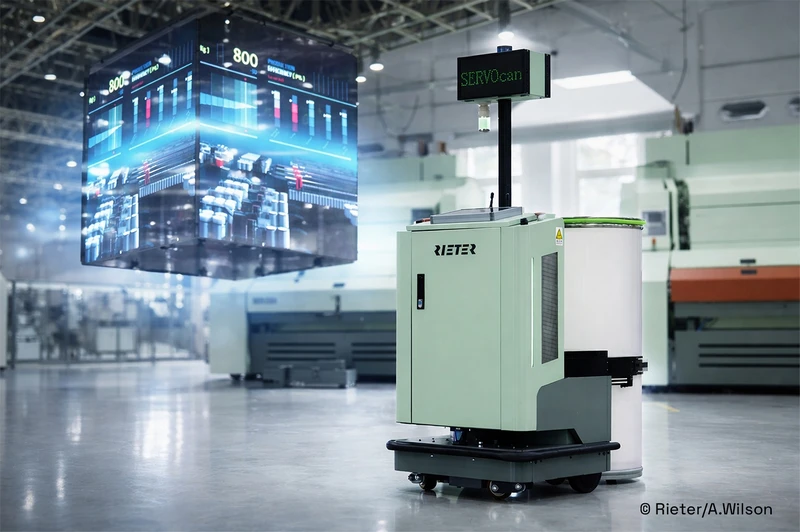
Rieter’s concept for the spinning mill of 2027 illustrates how Industry 5.0 thinking is being translated into concrete machinery investment ahead of ITMA 2027 in Hanover.
Digital connectivity is layering a further shift on top of these physical changes. Real-time production data and performance analytics mean technicians and operators can increasingly anticipate problems and adjust settings proactively, rather than reacting only once a fault has already affected output — a level of foresight that would have been unthinkable on a traditional mill floor. Training requirements are moving in parallel, shifting away from purely manual skillsets and toward hybrid competencies that combine textile process knowledge with digital literacy and a working understanding of process engineering.
The scale of investment behind the shift
This transition is not simply a matter of rhetoric; it is backed by a rising wave of capital investment. Industry forecasts from the research firm Technavio estimate that the global textile automation market will expand by approximately USD 664 million between 2024 and 2029, growing at a compound annual rate of 3.2 percent as mills pursue greater efficiency, flexibility and operational resilience. That figure sits inside a wider reskilling challenge documented across manufacturing generally: the World Economic Forum estimates that, of every hundred workers in the global workforce, 59 will need meaningful reskilling or upskilling by 2030, and that roughly a fifth of that group is unlikely to receive it without deliberate intervention. Fashion-industry-specific research echoes the same order of magnitude, projecting that up to 40 percent of workers in developed-market textile and apparel production will need to reskill by the end of the decade.
Selected data points shaping textile workforce and automation planning
Metric
Figure
Source
Global textile automation market growth, 2024–2029
+USD 664 million (3.2% CAGR)
Technavio
Global workforce requiring reskilling or upskilling by 2030
59 of every 100 workers
World Economic Forum
Developed-market textile/apparel workers needing reskilling by 2030
Up to 40%
State of Fashion 2026 report
ITMA 2027 exhibition footprint
200,000 sq m, 1,500+ exhibitors
CEMATEX / ITMA
ITMA 2027 expected visitorship
100,000+ industry professionals
CEMATEX / ITMA
The persistence of this reskilling gap across such different sources — a market-research firm forecasting equipment demand, a multilateral labour body, and an apparel-industry trend report — suggests the workforce transition accompanying textile automation is not a regional anomaly but a structural feature of the sector’s next decade, regardless of where in the world production is located.
An uneven transition across regions
That structural shift is landing very differently depending on where a mill sits in the global textile map. In Southeast Asia, where a large share of the world’s labour-intensive apparel production is concentrated, the same automation trends that promise efficiency gains also threaten a substantial number of jobs in economies where manufacturing employment underpins household income at scale. In Vietnam, textile and garment employers are already reporting a shift in hiring priorities toward hands-on technical capability, digital literacy and adaptability, moving away from a narrower focus on academic qualifications alone, as mechatronics and process-engineering roles multiply on the factory floor.
India offers a useful illustration of how public policy is attempting to close this gap proactively rather than reactively. National programmes such as the Samarth Scheme and the wider Skill India Mission are structured specifically to train textile workers in operating, troubleshooting and maintaining automated systems — robotic sewing platforms, computer-controlled looms and AI-enabled quality inspection tools among them — while sharing the financial burden of that training between government and employers rather than leaving it to individual mills. Programmes of this kind matter disproportionately in economies where textile manufacturing remains one of the largest sources of formal employment, because the alternative to structured reskilling is not a slower transition but an uneven one, in which only the best-capitalised producers can afford to modernise their workforce alongside their machinery.
Sustainability as a design constraint, not an add-on
The same digital infrastructure enabling this workforce shift is also being applied directly to the industry’s environmental footprint. Digital machine platforms now allow far more precise control over energy consumption, water usage and raw material efficiency, helping manufacturers reduce waste and make better use of resources throughout production. Advanced monitoring systems can track performance parameters in real time, allowing mills to identify inefficiencies quickly and take corrective action that reduces both operating costs and environmental impact simultaneously, rather than treating cost reduction and sustainability as competing goals.
Process integration and data-driven optimisation are also supporting shorter production runs, faster changeovers and more accurate demand forecasting — capabilities that directly address overproduction and excess inventory, two of the most persistent sources of material waste across the industry. Greater process stability is, in turn, making it more practical to work with recycled fibres and alternative raw materials without compromising product quality, which is gradually easing one of the long-standing trade-offs between sustainability commitments and manufacturing consistency.
ITMA 2027: where the next chapter will be written
Many of these developments will be on public display at ITMA 2027, the quadrennial International Textile Machinery Exhibition, which returns to Hanover, Germany, from 16 to 22 September 2027 — the first time the event has been staged in Germany in 36 years. Organised by ITMA Services on behalf of CEMATEX, the European Committee of Textile Machinery Manufacturers, the seven-day exhibition is expected to occupy roughly 200,000 square metres of exhibition space, host more than 1,500 exhibitors and draw upwards of 100,000 visiting industry professionals, making it the largest gathering of its kind anywhere in the world.
The exhibition’s chosen theme, “Co-creating the Future of Textiles,” is a deliberate signal of intent from CEMATEX leadership: the stated ambition is to move the industry from Industry 4.0 into Industry 5.0 not simply by automating further, but by humanising the technology involved, while accelerating the sector’s shift toward a circular economy built on collaboration and regeneration rather than linear resource consumption. Beyond the core exhibition floor, ITMA 2027 will expand its Start-Up Valley and Research & Innovation Lab initiatives, giving early-stage companies and academic research groups a dedicated platform to connect with established manufacturers and investors — a structural acknowledgement that the next generation of textile technology, much like the Jacquard loom before it, is unlikely to come from any single source.
The pattern, once again
In many respects, the current progression echoes the transformation first set in motion by the Jacquard loom two centuries ago. Early mechanisation reduced the relevance of certain traditional crafts, yet it simultaneously elevated the technical sophistication of textile production and broadened the range of opportunities available across the workforce. The debate playing out today over automation, AI and employment in textile manufacturing is, in that sense, a continuation of a conversation the industry has been having with itself since the 1820s — except this time, the explicit policy framework guiding the transition places the wellbeing of the worker, not just the efficiency of the machine, at the centre of the design brief. Whether that framework succeeds in practice will depend less on the sophistication of the technology on display at Hanover in 2027, and more on how deliberately manufacturers, governments and training institutions invest in the people who will operate it.
References
ITMA. “Industry 5.0 and the New Textile Workforce: The Future of Textile Manufacturing.” itma.com, 9 April 2026.
European Commission, Directorate-General for Research and Innovation (Breque, M., De Nul, L., Petridis, A.).
Technavio. “Automation Market in Textile Industry — Analysis, 2024–2029.” technavio.com.
World Economic Forum, Future of Jobs research, cited via industry reskilling commentary, 2026.
“State of Fashion 2026” report, cited in FESPA and TEXINTEL industry analysis, January–February 2026.
Vinatex. “Workforce Shifts in the Garment and Textile Industry: Employers Seek Work-Ready Talent.” vinatex.com.vn, 2026.
“Preparing the Textile Workforce for Automation,” on India’s Samarth Scheme and Skill India Mission, localandglobaleco.com, 2025.
ITMA 2027 exhibition details, Hanover, Germany, September 2025–2026 coverage.