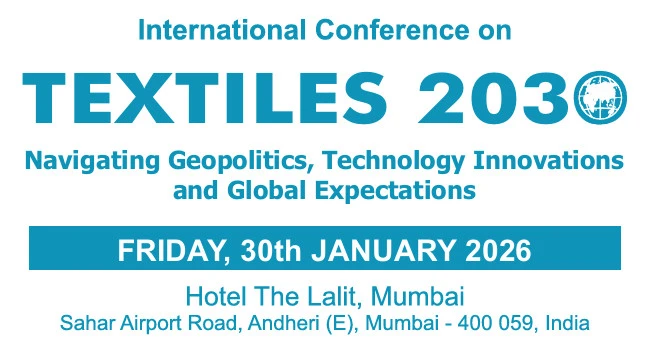
The Textile Association (India), Mumbai Unit is organizing an International Conference on “TEXTILES 2030 – Navigating Geopolitics, Technology Innovations and Global Expectations” on Friday, 30th January 2026 at Hotel The Lalit, Mumbai.
The conference aims to serve as a strategic platform that unites industry leaders, manufacturers, policymakers, trade bodies, academia and technology innovators to chart a road-map for a textile sector that is resilient, competitive, compliant, and future-ready. The Indian textile & apparel industry — the country’s second-largest employer after agriculture and the third-largest foreign exchange earner after IT and jewellery — has reached a critical inflection point, shaped by shifting trade alignments, tariff uncertainties, global conflicts, and changing consumer preferences.
India’s domestic textile market today stands as a pillar of strength with apparel and textiles valued collectively at USD 147 billion, coupled with a robust 10% CAGR over five years, expected to double to USD 300 billion in the next decade. With exports currently at USD 37 billion (apparel USD 16B, home textiles USD 8B, and yarn & fibre USD 13B), the sector’s ambition aligns with the government’s renewed focus on export-led competitiveness, self-reliance, and mega infrastructure investments. However, global market turbulence, especially arising from geopolitical developments such as the Russia-Ukraine conflict and the Israel-Gaza crisis, continues to disrupt supply chains and sourcing strategies, underscoring the urgency of adaptation and innovation.
To counter this volatility, India has been actively negotiating new Free Trade Agreements (FTAs) with key strategic partners, while also advancing value-added, design-led, and compliance-centered production models that elevate Indian textiles into smarter, sustainable, traceable and technology-enabled offerings for global buyers. The shift towards sustainability, certification, recycling, circularity, traceability and digital manufacturing is no longer optional — it is rapidly becoming the industry’s license to operate.
These realignments have created a fertile ground for innovation. Smart textiles, engineered fibres, technical textiles, and robotics-led manufacturing are reshaping the supply chain paradigm, while MITRA textile parks and modern logistics corridors are streamlining cost structures and enabling scale. Digital compliance, automated documentation, blockchain-enabled traceability, and certification protocols are not just industry initiatives — they are emerging as a competitive advantage for Indian producers aiming to consolidate sourcing within India’s borders and support the country’s evolution into a true end-to-end textile hub for global brands.
TEXTILES 2030 will explore five major thematic pillars — Geopolitics & Global Textile Realignments, Materials Innovation, Process Innovation & Technology, Global Sustainability Initiatives, and Women Leadership in T&A Sector — reflecting some of the most urgent and future-shaping trends in the textile value chain. Policy makers, global buyers, textile professionals, women leaders, and research experts are expected to present insights on compliance, decarbonisation, competitiveness, circularity, and supply chain transformation for 2030 and beyond.
The Textile Association (India), Mumbai Unit — with more than 4,500 members, and a long-standing legacy of hosting nationally and globally relevant conferences — continues to position Mumbai as a centre of informed discourse and industry-led knowledge exchange. The upcoming conference is expected to attract over 400 delegates, offering textile professionals a rare opportunity to engage directly with domain experts and decision makers from India and overseas.
Industry support has been instrumental in shaping the Association’s events, and this year’s edition benefits from a strong ecosystem of sponsors across diamond, silver, bronze and supporter tiers, reflecting the sector’s unified commitment to transformation and long-term competitiveness. Exhibiting partners will showcase new ideas, compliance solutions, and technologies that address the demands of an increasingly regulated and ESG-sensitive global marketplace.
By convening an international audience at a moment of global transition, TEXTILES 2030 aims to signal not merely the challenges confronting the Indian Textile & Apparel sector, but more importantly its determination to adapt, innovate and lead through sustainability, digitalisation, and resilience. The conference underscores the Mumbai Unit’s ongoing mission to stimulate informed dialogue, promote industry–academia collaboration, and strengthen India’s preparedness for a forward-looking textile economy that aligns with global expectations of 2030 and beyond.
Online Delegate Registration Form can be accessed here: