Textile Leaders Meet TN Chief Minister to Resolving Power related issues
Coimbatore (20th May 2026)
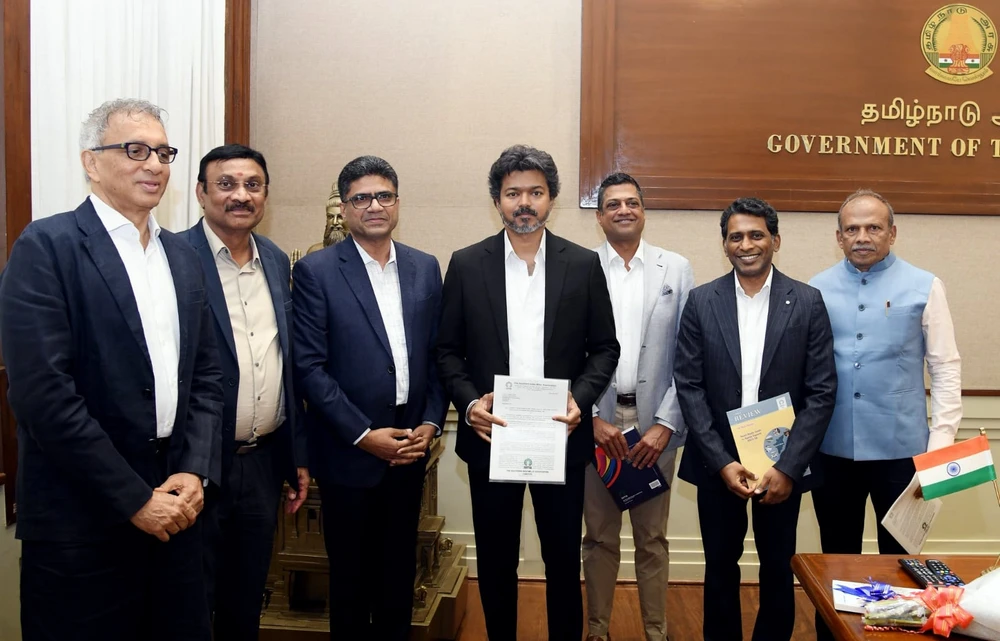
In a significant step towards strengthening Tamil Nadu’s position as India’s premier textile manufacturing hub, a high-level delegation from the Southern India Mills’ Association (SIMA) met the Hon’ble Chief Minister of Tamil Nadu today at his office in Chennai. The delegation expressed profound gratitude to the Chief Minister for his proactive intervention in sending a detailed D.O. letter to the Hon’ble Prime Minister, urging the removal of the 11% import duty on cotton—a levy that has severely strained the entire textile value chain by inflating raw material costs and eroding competitiveness against global players like Bangladesh and Vietnam.
SIMA, established in 1933 in Coimbatore and recognized as the single largest employers’ organization in the Indian textile sector, represents mills across South India and plays a pivotal role in fostering industry growth, employment, and exports. The delegation comprised distinguished leaders: Mr. T. Rajkumar, Former Chairman, SIMA; Mr. Ravi Sam, Vice Chairman of the Cotton Textiles Export Promotion Council (TEXPROCIL), Mumbai, and Former Chairman, SIMA; Mr. Ashwin Chandran, Chairman of the Confederation of Indian Textile Industry (CITI), New Delhi, and Former Chairman, SIMA; Mr. S. Krishnakumar, Deputy Chairman, SIMA; Mr. K. Sivaraj, Vice-Chairman, SIMA; and Dr. K. Selvaraju, Secretary General, SIMA.
The meeting provided a comprehensive briefing on the current scenario of the textile industry, with particular emphasis on Tamil Nadu’s contributions and challenges. Tamil Nadu has long held the mantle of numero uno in textile manufacturing, boasting a robust ecosystem spanning spinning, weaving, processing, garmenting, and technical textiles. The sector employs millions, drives substantial exports (with hubs like Tiruppur, Coimbatore, and Karur contributing significantly to the state’s economy), and supports ancillary industries. However, the delegation underscored the urgent need for sustained policy support and proactive initiatives to maintain this leadership amid rising costs, global competition, and recent headwinds such as mill closures—over 300 units have shut down in recent years due to high input costs, including power tariffs.
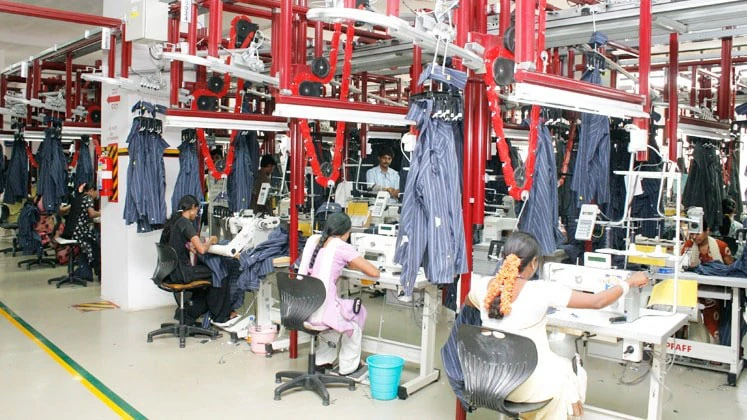
Garment manufacturing unit in Tiruppur
A core focus of the discussions was the steep escalation in power costs, which has become a major impediment to viability, especially for power-intensive spinning and processing units. Tamil Nadu’s industrial power tariffs remain higher than those in competing states, with recent hikes (around 3-3.4% for FY 2026) pushing rates to approximately Rs. 7.5 per unit plus demand charges. Many mills have turned to renewable energy, particularly rooftop solar and wind, to mitigate costs, but policy inconsistencies threaten these investments.
The delegation made specific, immediate appeals to the Hon’ble Chief Minister:
Withdraw the collection of network charges on rooftop solar power generation, in line with the Madras High Court’s orders that have struck down such levies as lacking legal basis and conflicting with renewable energy promotion policies. This would provide much-needed relief to industries that have invested heavily in captive solar to reduce grid dependency.
Keep in abeyance the collection of arrears related to deemed demand charges until the Appellate Tribunal for Electricity (APTEL) issues a final order, offering interim financial breathing space.
Freeze demand charges at the current rate of ₹608 per kVA per month for a period of three years to ensure cost predictability and support long-term planning and investment.
Beyond power issues, the delegation urged accelerated implementation of key central and state schemes. They appealed for adequate fund allocation and speedy rollout of the PM MITRA Park Scheme in Virudhunagar—a flagship 1,052-acre greenfield integrated textile park designed to create world-class infrastructure, attract large-scale investments (with recent allotments already unlocking thousands of crores and jobs), reduce logistics costs by housing the full value chain, and boost exports.
They also sought robust support for the Tamil Nadu Integrated Textile Policy (including the updated 2025-26 version), which emphasizes modernization of looms, capital subsidies for processing units, technical textiles, sustainable practices, interest subventions, and infrastructure development to position the state as a global sourcing hub. Additional schemes for skill development, research, and diversification into man-made fibres and technical textiles were highlighted as critical for future growth.
The Chief Minister attentively heard the concerns and assured the delegation of the government’s continued commitment to the textile sector as a cornerstone of Tamil Nadu’s economic progress. This collaborative engagement reflects a shared vision to overcome challenges, enhance competitiveness, retain and create employment, and realize the industry’s full potential in contributing to national exports and the state’s ambitious development goals.
SIMA remains optimistic that swift government action on these fronts will rejuvenate the sector, safeguard livelihoods, and reinforce Tamil Nadu’s leadership in India’s textile landscape.