SIMA Chairman wants the industry to accelerate automation and value addition
The Indian textile industry is entering a new phase of transformation in which diversification, technology adoption, sustainability and value addition will decide long-term global competitiveness. India has long built its strength on natural fibres, especially cotton. The rapidly changing world market now requires a much stronger presence across the full textile value chain, including man-made fibres, technical textiles, recycled fibres and other sustainable, value-added products.
Future growth will not come from capacity expansion alone. It will come from making higher-value products more efficiently through innovation, productivity, advanced technology, sustainability and wider market access. Those steps, the industry argues, will help India make the most of opportunities created by new Free Trade Agreements.
This was the message from Mr Durai Palanisamy, who was unanimously re-elected Chairman of The Southern India Mills’ Association (SIMA) for 2026-27. In a press release issued in Coimbatore today, he thanked the NDA government for consistently treating textiles as a priority and for a series of growth-oriented measures. These include rationalisation of GST across the textile value chain; withdrawal of Quality Control Orders on cotton, MMF fibres, filaments and yarns; retention of the annual banking system for power and a reduction in related charges; extension of the export obligation period under Advance Authorisation; launch of the Mission for Cotton Productivity; revisions to the PLI Scheme with lower investment and turnover thresholds; progress on FTAs with the EU, the UK, New Zealand, Oman and other countries; export credit support, restoration of RoDTEP and extension of RoSCTL; a temporary exemption of cotton from the 11 per cent import duty; rollback of a punitive U.S. tariff from 50 per cent to 18 per cent; reduction of the Hank Yarn Obligation from 30 per cent to 20 per cent; rejection of anti-dumping duty recommendations on elastomeric filament yarn; introduction of ECLGS 5.0 to ease liquidity with fully collateral-free additional credit of up to 20 per cent of peak working capital, subject to a ceiling of Rs 100 crore per borrower, a tenure of up to five years till 31 March 2027 and a one-year moratorium on principal repayment; and withdrawal of a proposed 3.48 per cent power tariff increase in Tamil Nadu.
Mr Palanisamy also appealed to the government to tackle growing volatility in cotton prices, which account for about 65–70 per cent of yarn manufacturing cost. He said speculation in raw material prices must be curbed if the entire value chain is to have a level playing field. He urged two specific steps: permanent removal, with immediate effect, of the 11 per cent import duty on all varieties of cotton, so as to check the import-parity pricing practised by multinational traders and the Cotton Corporation of India; and a rethink of CCI’s role along the lines of China’s National Cotton Reserves Corporation, which holds more than a year’s stock and uses it to keep prices stable.
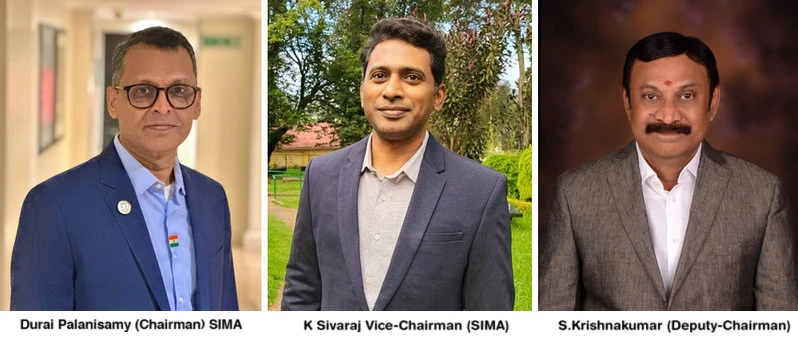
The 67th Annual General Meeting of SIMA was held at the association’s premises in Coimbatore on 22 September 2026. Mr Durai Palanisamy, Executive Director of Pallava Textiles P Limited, Erode, was re-elected Chairman. He holds an MBA in International Business from Southern New Hampshire University and a B.Tech in Textile Technology from PSG College of Technology. He is Vice-President of CII, Erode Zone, and serves on the Committee of Administration of the Manmade and Technical Textiles Export Promotion Council (MATEXIL).
Mr S. Krishnakumar, Managing Director of Sulochana Cotton Spinning Mills P Ltd., Tiruppur, was unanimously re-elected Deputy Chairman. He holds a B.A. in Psychology from P.S.G. Arts College, Coimbatore, and entered the business in the late 1980s. His company focuses on sustainable fashion and converts used PET bottles into recycled yarns and fabrics. He also heads the newly formed Tirupur Yarn Manufacturers Association.
Mr K. Sivaraj, Managing Director of Sivaraj Spinning Mills (P) Ltd, Dindigul, was unanimously re-elected Vice-Chairman. He holds a B.Tech in Textiles from the United States and entered the industry in the late 1990s. Sivaraj Spinning Mills is a leading domestic player across yarn, woven fabric, knitted fabric and ready-made garments, and is shifting traditional manufacturing toward modern retail branding.
The release was issued from Coimbatore on 22 September 2026 by Dr K. Selvaraju, Secretary General of SIMA.