
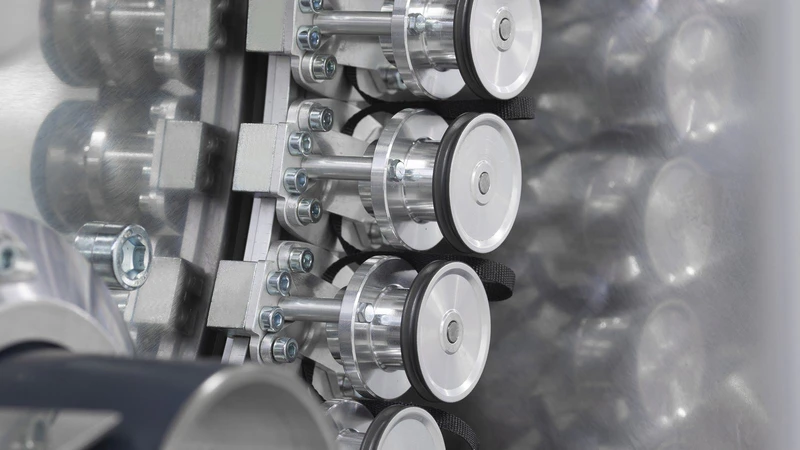
The new Barmag WINGS POY 2.0 winder, the core of the POY 2.0 spinning concept, which offers fully automatic string-up for the first time. Photo: Barmag (Rieter Group)
Barmag puts POY 2.0 at the centre of its Shanghai stand
Barmag, the man-made fibre machinery business of the Rieter Group, is showing a new partially oriented yarn (POY) concept at ITMA ASIA + CITME 2026 in Shanghai (Hall 6.1, booth D45, shared with Rieter). The company calls it a re-engineering of the whole POY process chain, not a machine upgrade. At its centre is the new WINGS POY 2.0 winder, which Barmag says is the first to offer a fully automatic string-up function. Barmag says automatic string-up shortens start-up times, cuts waste and reduces operator intervention, which matters as spinning mills face skilled-labour shortages.
“For decades, productivity improvements in spinning were often measured in percentages. With POY 2.0, we set out to rethink the entire process from the ground up,” said André Wissenberg, Head of Marketing, Corporate Communications and Public Affairs at Barmag. “The result is a solution that simultaneously addresses the industry’s most pressing challenges: efficiency, quality, sustainability, and workforce availability. This is not a machine upgrade. It is a new production philosophy.”
Around the winder, the new DIO Spin Pack Generation 2 is more compact, uses about one-third less filter sand and weighs more than 30% less, while giving more uniform filaments. A redesigned spinning beam with smaller surface areas saves up to 10% of energy, and the EvoQuench 2.0 quench system makes adjustments simpler and cuts off-quality during product changes. Barmag’s atmos.io platform gives each bobbin a digital identity from polymer processing to the warehouse. “The future competition among yarn manufacturers will not be decided by who owns the most machines. It will be decided by who can transform production data into actionable intelligence,” Wissenberg said.
The rest of the stand covers the whole man-made fibre chain. WINGS FDY FLEX is a winding concept with a wide production window for frequent product changes, including recycled polyester. The eFK EvoSmart texturing machine uses an EvoHeater with exchangeable inserts and Smart Godets to cut specific energy use by up to 25% per kilogram of yarn and maintenance effort by up to 50%. In June 2026 Barmag partnered with India’s Hitech Automation Solutions to retrofit the Doffmatic automatic doffer to eFK machines.
Barmag’s Neumag product line is showing the EvoSteam staple-fibre process for energy savings, robotic spin-pack cleaning, and BICO BCF carpet yarn, which Barmag says delivers carpet bulk and recovery with about 20% less face fibre. FiberGuard BCF, also on show, measures yarn tension in real time and can be retrofitted to existing lines. In nonwovens, the patented hycuTEC process reaches electrostatic charging efficiencies of up to 99.99% in meltblown media using osmosis-treated water. Barmag Huitong Engineering is presenting melt homogenisation for thermomechanical recycling of post-industrial polyester such as bottle flakes and film.
“The industry stands at a turning point. The producers who will lead tomorrow are those who embrace innovation today,” Wissenberg said. China is the world’s largest market for polyester filament spinning, and producers there and in India are under pressure on margins and labour. Automatic string-up and lower energy and consumable costs per kilogram are the features most likely to shape new POY investment decisions.
Related Posts:
Powered by Contextual Related Posts