Knit-Tech 2026: Tirupur’s Knitting Trade Fair Comes of Age
Inside the 18th edition of Asia’s largest knitting technology exhibition, where four days of machinery, dealmaking, and dialogue reaffirmed the knitwear capital’s place at the centre of India’s textile ambitions.
TIRUPUR, TAMIL NADU • MARCH 6–9, 2026 • HI-TECH TIRUPUR EXHIBITION CENTRE
The exhibition floor at Knit-Tech 2026, held across four German-structure halls at the Hi-Tech Tirupur Exhibition Centre on Ring Road, Thirumurugan Poondi. Photo: Knitting Views.
For four days in early March, the dusty ring roads leading into Thirumurugan Poondi on the outskirts of Tirupur carried a heavier-than-usual stream of traffic. Container trucks bound for the town’s thousand-odd knitwear units shared space with chartered coaches, machinery-laden trailers, and a steady procession of factory owners, production heads, and overseas technology suppliers making their way to the Hi-Tech Tirupur Exhibition Centre. The occasion was Knit-Tech 2026, the eighteenth edition of a trade fair that has, over twenty-seven years, become inseparable from the identity of the town it calls home. Billed as Asia’s largest knitting technology trade fair, the show ran from March 6 to 9 and closed with organisers describing it as one of the strongest editions in its history.
Tirupur’s claim to the title of India’s Knitwear Capital is not a marketing flourish; it is closely tied to hard numbers. The cluster contributes close to 90 per cent of the country’s total knitwear exports and, through the Tiruppur Exporters Association, has set its sights on a trillion-rupee export target by 2030. It is against this backdrop of scale, ambition, and mounting global trade pressure that Knit-Tech has, since its first edition in 1993, positioned itself as the town’s principal shop window for the machinery that keeps its mills running. The 2026 edition arrived at a moment when that positioning mattered more than usual, with Tirupur’s exporters navigating tariff uncertainty in the United States and shipping disruptions linked to the West Asia crisis even as they pushed to modernise and diversify their production base.
I. An Inauguration Rooted in Industry Leadership
The show was formally inaugurated by Dr A. Sakthivel, Chairman of the Apparel Export Promotion Council, and K. M. Subramanian, President of the Tiruppur Exporters Association, in the presence of association members and other industry leaders. Their joint presence at the ribbon-cutting was itself a statement: AEPC and TEA sit at the two ends of the value chain that Knit-Tech exists to serve, one representing India’s apparel exporters on the national and international stage, the other speaking specifically for the knitwear cluster that Tirupur has built over four decades.
The welcome address was delivered by M. A. Rayappan, Chairman of Knit-Tech and the founder of Hi-Tech International Trade Fair India, the company that has organised every edition of the show since its inception. Rayappan’s remarks struck a note of gratitude and continuity rather than triumphalism, thanking exhibitors, visitors, speakers, partners, and industry associations for what he called a successful and impactful gathering.
“The strong engagement from the industry reflects the growing importance of technology and innovation in strengthening the textile and apparel sector. Knit-Tech continues to serve as an important platform connecting global knitting technology providers with the vibrant Tiruppur apparel manufacturing ecosystem.” — M. A. Rayappan, Chairman, Knit-Tech
Hi-Tech International itself has grown alongside the show it built. Founded in 1993, the company today operates branch offices across Coimbatore, Chennai, Bangalore, and Mumbai, as well as international outposts in Singapore and China, and has positioned Knit-Tech as an ITPO-recognised exhibition that adheres to international trade fair standards. That institutional continuity, rare among regional trade shows, is part of why exhibitors and buyers alike treat the biennial event as a fixture on the industry calendar rather than a one-off promotional exercise.
Knit-Tech 2026 at a Glance
220+ Exhibitors, from 14 countries
350 Stalls across the show floor
20,000 m² Gross exhibition space
4 Air-conditioned German-structure halls
26,740 Trade visitors over four days
₹860 cr Business generated, per organisers
II. A Full Value Chain Under One Roof
What distinguishes Knit-Tech from more narrowly themed textile fairs is its insistence on covering the entire knitted-garment manufacturing value chain in a single venue. The 2026 edition held to that formula, with exhibitors spread across knitting machinery, dyeing and finishing technologies, compacting and garment processing solutions, CAD/CAM design systems, embroidery and printing technologies, sewing and garment manufacturing machinery, textile chemicals and auxiliaries, and a long tail of accessories and allied equipment. For a buyer walking the halls, it was possible to trace, almost physically, the journey a cone of yarn takes before it becomes a folded T-shirt ready for export.
Live machinery demonstrations were a central draw, allowing visiting production managers to watch equipment run under near-factory conditions rather than judge it from a brochure. Organisers reported that more than 90 per cent of exhibitors came away satisfied with visitor response and footfall — a figure that, in an industry where exhibition budgets are scrutinised closely, tends to matter as much to organisers as raw attendance numbers.
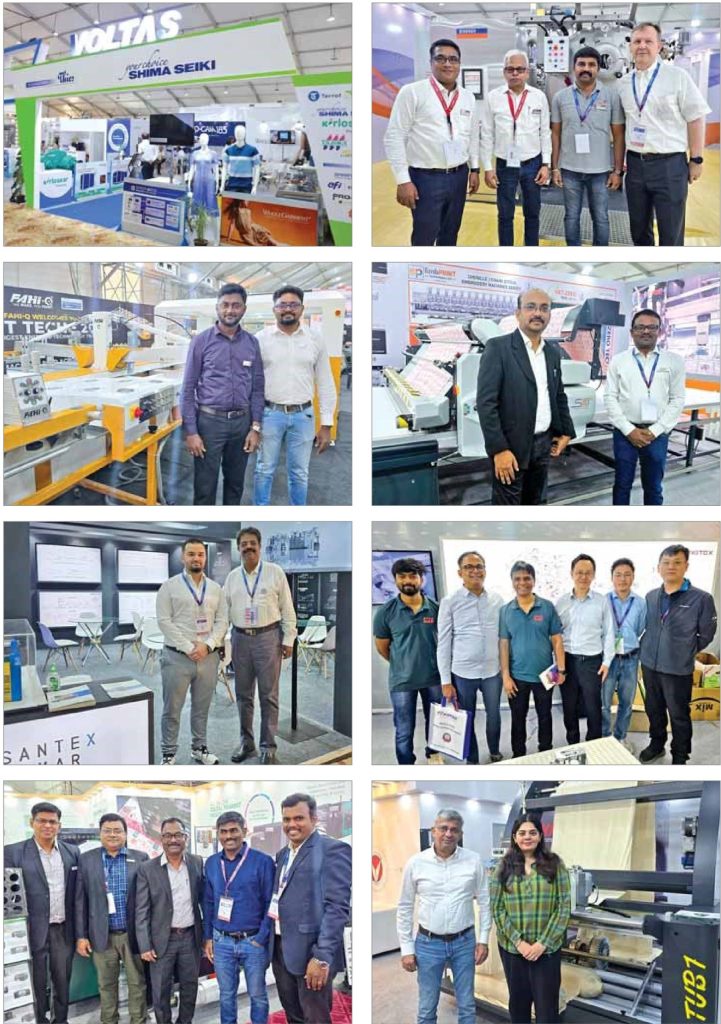
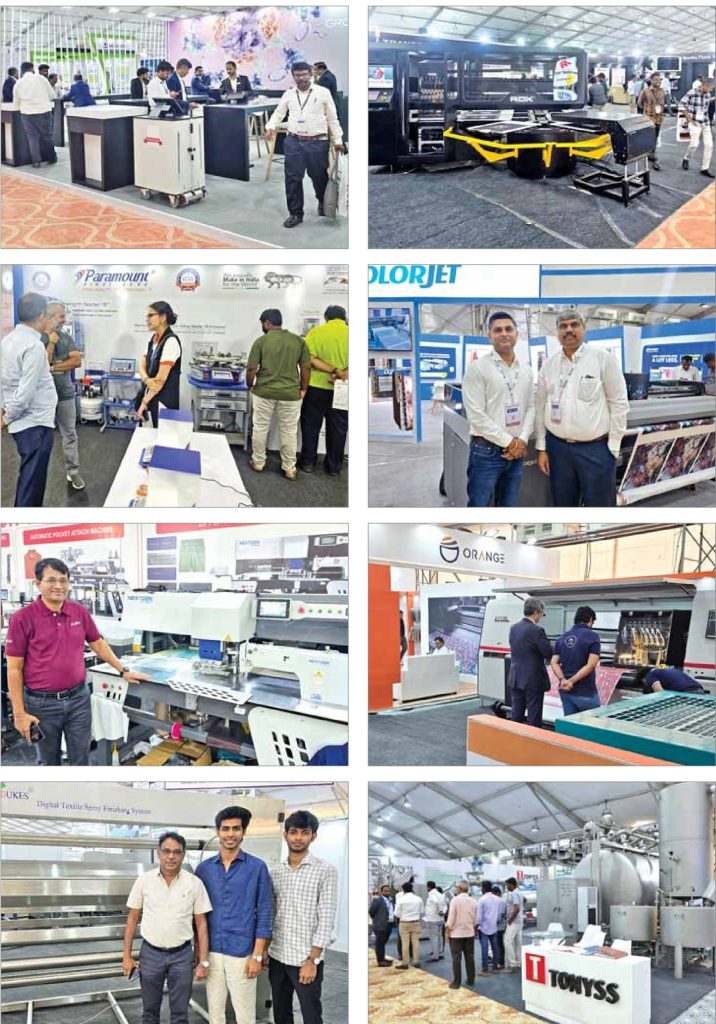
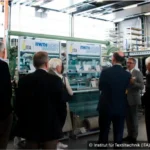
Buyers and exhibitors engage over machinery on the show floor during the four-day exhibition.A live equipment demonstration in progress — a format organisers say drives much of the fair’s on-the-spot dealmaking.
Among the international names present was Japan’s Shima Seiki, a leading supplier of computerised flat knitting technology, which exhibited in partnership with its Indian associate, Universal MEP Projects & Engineering Services. The company used the platform to introduce its N.SSR®132 garment-shaping machine in 14 gauge to the Tirupur market, framing the equipment as a route toward more sustainable production through shaping technology that reduces fabric waste. Germany’s Setex Schermuly Textile Computer also took a booth, demonstrating its OrgaTEX X3 manufacturing execution system alongside its E390 process controllers and FabricInspector Mobile tool — software-and-hardware combinations aimed squarely at the dyeing and finishing mills that cluster around Tirupur’s knitting units, and pitched around the increasingly urgent industry themes of energy use, water consumption, and quality-claim reduction. Their presence alongside a large contingent of domestic manufacturers underlined a pattern visible across the hall: global machinery brands increasingly see Tirupur not as a peripheral market but as a proving ground for technology aimed at India’s cost-sensitive, high-volume knitwear production.
III. Beyond the Show Floor: The Yi Learning Conclave
Trade fairs of Knit-Tech’s vintage have increasingly had to justify their place against a calendar crowded with sector-specific expos and digital sourcing platforms, and the organisers used the 2026 edition to broaden the show’s offering beyond machinery displays. A special seminar, styled the Yi – Knit-Tech Learning Conclave, was organised in collaboration with Young Indians, the youth wing of the Confederation of Indian Industry. The conclave brought industry experts together for panel discussions aimed at the next generation of textile manufacturing leadership, addressing where the sector’s technology, workforce, and business models are headed rather than simply what machines are for sale this season.
The format reflects a broader shift already visible in how Tirupur’s associations talk about the future: alongside export figures and machinery orders, there is a growing emphasis on skilling, succession, and the digital and sustainability literacy of the cluster’s next cohort of entrepreneurs, many of whom will inherit family knitting and garmenting businesses built in the 1980s and 1990s export boom.
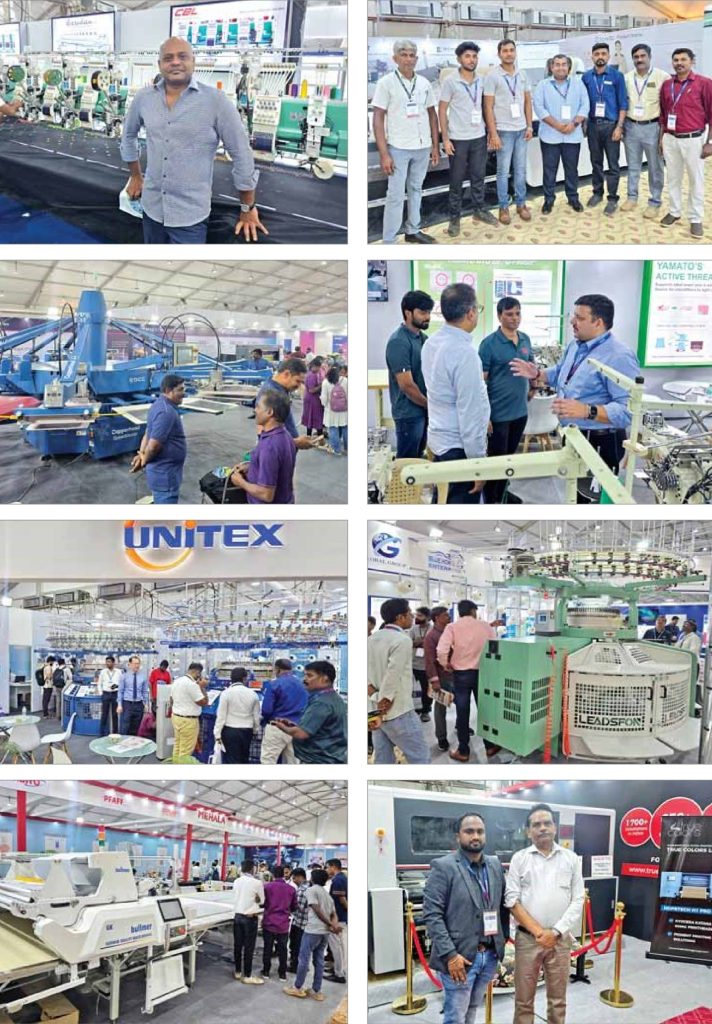
Delegates move between halls at the Hi-Tech Tirupur Exhibition Centre during Knit-Tech 2026’s four-day run.
IV.The Cluster Knit-Tech Serves
To understand why a machinery fair in a mid-sized Tamil Nadu town draws exhibitors from fourteen countries, it helps to look at what Tirupur has built over the past four decades. The town’s knitwear story began modestly, with the first knitwear unit established as early as 1925, but its export identity took shape only in the early 1980s, when an Italian buyer’s interest in white T-shirts opened a channel to European retail chains that has never really closed. By the early 1990s Tirupur was exporting over a thousand crore rupees’ worth of knitwear annually; today, the Tiruppur Exporters Association counts the cluster’s knitwear sector as employing roughly six lakh workers directly — the majority of them semi-literate women drawn from surrounding rural areas — plus another two lakh indirectly.
Tirupur Garment Exports: Recent Trend
Fiscal Year
Export Value
Movement
2023–24
₹33,400 crore
—
2024–25
₹44,747 crore
Up sharply, post-pandemic recovery
2025–26
₹42,544 crore (approx. $4.45 bn)
Down 4.9%, on US tariffs and West Asia disruption
That last figure is the one weighing most heavily on conversations in Tirupur this year. TEA president K. M. Subramanian, the same industry leader who inaugurated Knit-Tech, has been candid in attributing the fiscal 2025–26 dip largely to tariff-related uncertainty in the United States, which alone absorbs roughly a third of Tirupur’s shipments, and to trade and shipping disruption stemming from the West Asia crisis. Even so, exporters have pointed to the resilience of maintaining exports above ₹42,500 crore under those conditions, and TEA continues to talk in terms of ambitious medium-term targets rather than retrenchment — a trillion rupees in exports by 2030, underpinned by free trade agreements, growing demand for man-made-fibre garments, and continued investment in sustainable production, including the cluster’s widely cited zero-liquid-discharge water recycling systems.
It is precisely this combination of external pressure and stated ambition that gives a machinery fair like Knit-Tech its commercial logic. Diversifying into man-made-fibre knitwear, meeting rising compliance and traceability expectations from Western buyers, and improving per-worker productivity to offset tariff-driven margin pressure all require capital investment in new equipment — investment decisions that are frequently made, or at least seeded, on a Tirupur show floor rather than through a cold catalogue.
V. A Legacy Measured in Editions
Knit-Tech’s organisers are fond of noting that the fair has, across eighteen editions and twenty-seven years, helped both domestic and international knitting equipment manufacturers build lasting relationships with the Indian textile industry — relationships, they argue, that benefit vendors and buyers in roughly equal measure. It is a claim borne out by the show’s own trajectory: from a modest launch in 1993 to a 2026 edition spanning 20,000 square metres, four purpose-built halls, and exhibitors drawn from fourteen countries. The show’s own historical materials describe it as unlocking a market worth billions of dollars in knitting machinery and accessories for the Tirupur cluster alone, a figure that, whatever its precision, captures the scale of capital equipment the town’s knitting and garmenting units cycle through as they chase efficiency, compliance, and export competitiveness.
As the halls emptied out on the evening of March 9 and exhibitors began crating their machinery for the journey home, the numbers organisers put forward — 26,740 visitors, ₹860 crore in business, satisfaction levels above 90 per cent among exhibitors — told one version of the story. The other version was less quantifiable: a knitwear cluster under real tariff and currency pressure, choosing nonetheless to spend four days looking hard at the next generation of machines it will need to stay competitive. With the nineteenth edition now on the horizon for 2028, and with Tirupur’s own export targets climbing toward a trillion rupees by decade’s end, Knit-Tech’s organisers and the industry it serves appear to be betting on the same thing: that the path through tariff walls and shifting global sourcing patterns runs, in no small part, through better machines.