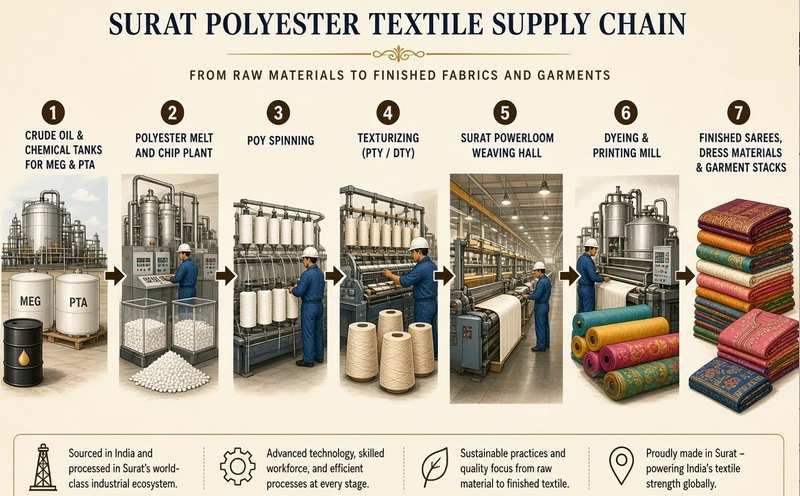
How the chain runs in Surat Feedstock — MEG and PTA (linked to crude) Melt / chips — mostly concentrated with a few large producers POY — partially oriented yarn PTY / DTY — texturized yarn used by weavers Powerlooms — Surat cluster (~1.52 lakh MT yarn a month) Processing — dyeing, printing, finishing Market — sarees, dress materials, garments, exports The SGCCI complaint sits mainly between steps 2–5: melt and POY conversion costs jumped, so weavers and MSMEs further down the chain absorb a burden of over ₹20/kg.
Surge in Polyester Yarn Prices Puts Textile Industry in Crisis Surat cluster consumes 1.52 lakh metric tonnes a month; SGCCI seeks Union Minister Giriraj Singh’s intervention
Surat Textile Industry Seeks Urgent Measures to Curb Polyester Yarn Price Surge
Surat, September 2026: The polyester textile industry in Surat and across India is facing growing cost pressures following a sharp increase in the prices of polyester melt and partially oriented yarn (POY), prompting industry representatives to seek urgent intervention from the Union Ministry of Textiles and other concerned authorities.
Surat’s textile cluster consumes around 1.52 lakh metric tonnes of polyester yarn every month, and the sustained increase in raw-material and yarn prices is having a direct impact on manufacturers, processors, weavers and downstream textile businesses. Industry representatives have attributed the recent price escalation to developments in the domestic polyester market following changes in customs-duty arrangements on Mono Ethylene Glycol (MEG) and Purified Terephthalic Acid (PTA), along with what they describe as an abnormal increase in polyester melt and POY prices.
The issue was highlighted by Ashok Jirawala, a prominent representative of the Southern Gujarat textile industry, who has sought the intervention of Union Minister for Textiles Giriraj Singh. According to industry representatives, international crude-oil movements do not appear to justify the magnitude of the increase currently being witnessed in polyester melt prices. They pointed out that, under normal price relationships, a change of about US$5 per barrel in crude oil prices should result in only around ₹2 per kg movement in polyester melt prices. However, the industry has reported a much larger increase at the domestic melt stage.
The impact becomes even more pronounced when the cost of converting polyester melt into POY is taken into account. Industry representatives stated that the conversion cost, which was earlier in the range of ₹15–16 per kg, has reportedly risen to around ₹26.07 per kg. As a result, the combined impact of higher melt prices and conversion costs is placing an additional burden of more than ₹20 per kg on local manufacturers.
The industry has also drawn attention to the divergence between crude-oil prices and domestic polyester melt prices. According to comparative figures presented by industry representatives, when crude oil was around US$126 per barrel on April 30, polyester melt was priced at approximately ₹109.63 per kg. With crude subsequently declining to around US$84–92 per barrel, the melt price is still being quoted at about ₹105.93 per kg. Industry calculations suggest that the price should instead be closer to ₹95 per kg at current crude-oil levels. The industry has therefore questioned the basis for the continued price differential.
The matter was also taken up during a high-level meeting between the Chamber of Commerce and industry representatives and the Ministry of Textiles in New Delhi. The industry presented comparative data on polyester yarn and melt prices and sought concrete measures to prevent arbitrary price escalation and protect the competitiveness of India’s textile manufacturing sector.
Among the key demands is the creation of a Price Monitoring Committee for polyester yarn and its key raw materials. Industry representatives have proposed that such a mechanism should regularly monitor the prices of crude oil, polyester melt, MEG, PTA and POY and examine whether domestic price movements are in line with international raw-material trends. They have argued that greater transparency and continuous monitoring would help prevent abnormal price increases and provide greater stability to the textile value chain.
The industry has also sought duty-free imports of MEG, PTA and polyester yarn, arguing that removal or reduction of customs duties on these critical inputs could increase competition in the domestic market and help contain raw-material costs. According to the industry proposal, customs duty on polyester yarn and related inputs should be brought down to zero to enable manufacturers to access internationally competitive raw-material prices.
Steep rise in international freight costs
Another major concern is the steep rise in international freight costs. Industry representatives pointed out that the freight on a US$1,000 container has increased to around US$4,000, substantially increasing the landed cost of imported textile raw materials and products. With India dependent on international trade for several critical inputs and textile markets, the industry has requested the government to consider a freight subsidy to partially offset the extraordinary increase in transportation costs.
The industry has suggested that freight support is particularly important in view of the competitive international textile market. With container freight reportedly having increased several-fold, exporters and manufacturers face additional costs even when raw-material prices are stable. A targeted freight-support mechanism, according to the industry, could provide temporary relief while preserving the competitiveness of Indian textile products in global markets.
Representatives have further proposed that the government establish a joint monitoring mechanism involving the industry and relevant government agencies, with periodic review of polyester-chain prices and international benchmarks. They have also suggested measures to ensure that domestic manufacturers are not placed at a disadvantage compared with overseas producers who may have access to lower-cost polyester inputs.
The issue assumes particular significance for Surat, one of India’s largest man-made textile manufacturing and processing centres. The city’s extensive network of yarn manufacturers, texturisers, weavers, processors, traders and garment and textile-product manufacturers makes the polyester value chain critical to the regional economy. Any sustained increase in yarn prices has a cascading effect across the entire chain, ultimately affecting production costs and the competitiveness of textile products.
The industry has therefore urged the Ministry of Textiles and the Union Government to examine the price structure of polyester melt and POY, review the impact of customs-duty changes on MEG and PTA, consider duty-free imports of essential polyester-chain inputs, introduce a freight-support mechanism and establish a permanent price-monitoring committee. The objective, industry representatives emphasised, is not merely to control prices but to establish a more transparent and competitive pricing mechanism that can provide stability to India’s man-made textile sector.
With polyester-based textiles accounting for a substantial share of India’s textile manufacturing and Surat emerging as a major global hub for man-made textiles, industry representatives believe that timely policy intervention will be important for maintaining cost competitiveness, supporting domestic manufacturers and strengthening India’s position in international textile markets.