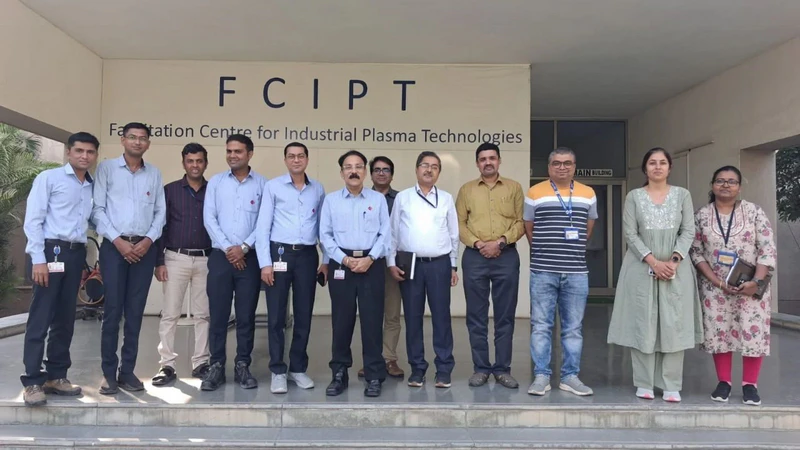
Scientists from MANTRA, Surat, with Institute for Plasma Research staff during their visit to IPR’s Facilitation Centre for Industrial Plasma Technologies (FCIPT), Gandhinagar.
MANTRA and the Institute for Plasma Research Partnership
Surat’s MANTRA and the Institute for Plasma Research team up on plasma pyrolysis of polyester and blended textile waste and on dry plasma treatment for industrial technical textiles
The Man-Made Textiles Research Association (MANTRA), Surat, and the Institute for Plasma Research (IPR), Gandhinagar, have started a new research collaboration on plasma-based technologies for textile processing, textile-waste treatment and industrial technical textiles (Indutech). It was agreed during a visit by a team of MANTRA scientists and engineers to IPR. The two institutes have worked together before, with support from the Government of India’s Department of Science and Technology (DST).
MANTRA’s delegation was led by Director and Scientist Dr Pankaj Gandhi, with Deputy Director and Scientist Dr Hitesh Jarivala, engineers Himanshu Desai and Bhavdeep Shah, and Dr Chintan Bhagat. IPR was represented by Mr Chandwani, Dr Jain and Chetan Jarivala. In their earlier DST-backed work, the two institutes developed an inline plasma treatment system for textile processing that modifies fibre and fabric surfaces. Such systems can improve wetting, adhesion, coating, printing and lamination, and plasma-based dry processing can cut the water and chemicals used in desizing, scouring, bleaching and finishing.
The new programme adds waste and Indutech applications. The teams discussed plasma pyrolysis for disposing of polyester-based waste, blended-fibre waste and industrial textile residues. In plasma pyrolysis, very high-temperature plasma breaks down difficult waste in a controlled way, recovering useful gases and other value-added resources. The institutes describe this as a waste-to-resource route for the circular economy. Polyester-cotton and other blends cannot easily be recycled mechanically or chemically, and Surat produces large volumes of such waste.
In technical textiles, the partners see plasma treatment improving the surface quality, adhesion and functional performance of industrial filtration media, high-performance fabrics, protective clothing, coated and laminated fabrics, and composite materials, and helping the domestic production of high-performance technical textiles. MANTRA and IPR said they intend to carry out joint R&D, prototype development, pilot-level testing and new technologies built around industry needs, with Surat and South Gujarat’s MSME textile units as the main intended users.
Surat is India’s largest cluster for man-made fibre weaving and processing, and its processors are under pressure over water use, effluent and the disposal of mixed synthetic waste. A cluster-level research association working with a national plasma laboratory on equipment that MSMEs can afford could speed up the use of dry surface treatment in coating and lamination plants. Plasma pyrolysis will need pilot data on energy balance and gas yields before mills can treat it as an alternative to landfill or co-processing.