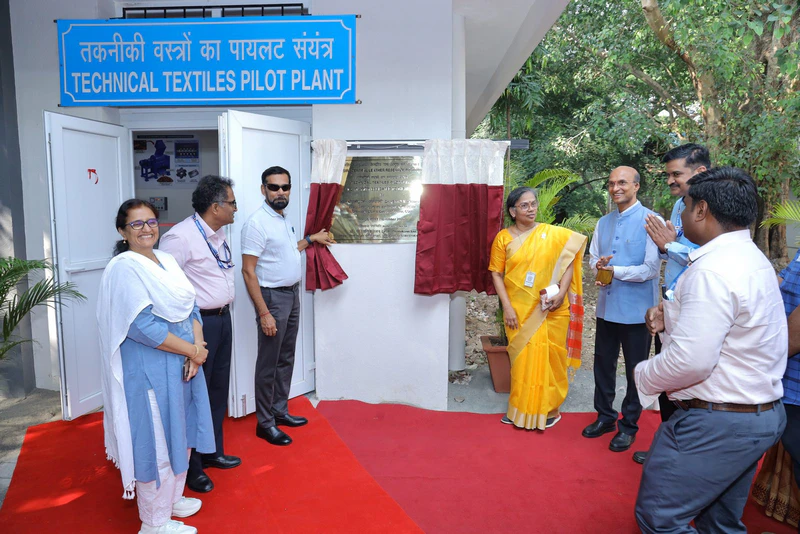
Dr N. Kalaiselvi, Secretary DSIR and Director General, CSIR, inaugurates the Technical Textile Pilot Plant at CSIR-Central Leather Research Institute, Chennai.
CSIR-CLRI opens a six-machine technical textile pilot plant in Chennai
CSIR-CLRI opens a six-machine technical textile pilot plant in Chennai, from miniature carding and rotor spinning to needle-punching, for material trials using fibres and leather waste
The Council of Scientific and Industrial Research (CSIR) has opened a Technical Textile Pilot Plant at its Central Leather Research Institute (CSIR-CLRI) in Chennai. The plant gives the leather, footwear, textile and allied industries shared access to equipment for developing materials, making prototypes and validating processes. It was inaugurated on 20 November by Dr N. Kalaiselvi, Secretary of the Department of Scientific and Industrial Research (DSIR) and Director General of CSIR, according to a release from the Press Information Bureau.
The pilot plant has six facilities: a miniature carding machine, a miniature rotor spinning machine, a needle-punching nonwoven machine, a fibre extracting and grinding machine, a leather-scraps shredder and a yarn-coating machine. Together they take a material from fibre opening and recovery to carded web, rotor yarn, coated yarn and needle-punched nonwoven at laboratory and pilot scale. The government says the plant “serves as an industry-support platform to reduce development risks, improve resource efficiency, promote sustainable manufacturing and enhance competitiveness”. At the inauguration the Director General watched technical textiles being made from natural and synthetic fibres on the line.
The ceremony was attended by Dr B. Chandrasekaran, former Director of CSIR-CLRI and Distinguished Scientist of CSIR; Dr K.J. Sreeram, former Director of CSIR-CLRI and Outstanding Scientist of CSIR; Dr Thallada Bhaskar, Director of CSIR-AMPRI; and scientists and industrialists. CSIR-CLRI Director Dr P. Thanikaivelan welcomed the guests. The Director General also opened a high-resolution 600 MHz NMR spectrometer, which will support the institute’s research on sustainability, footwear, apparel and components, collagen products and biomaterials.
Two technology transfers were signed at the same event. CSIR-CLRI licensed its “CLI-Mate” carbon-footprint assessment platform for the leather industry, which the government describes as a first-of-its-kind sector-specific digital tool for assessing greenhouse-gas emissions in leather processing and waste treatment, to Sai Chamois Inc., KAR Leathers Pvt. Ltd. and Vaigai Leathers of Dindigul and VRS Leathers of Chennai. It also licensed a water-based, bio-based polyurethane–silica leather-coating technology, developed under CSIR’s Speciality Chemicals Mission Mode project, to Kshetragna Agronym Pvt. Ltd., Hyderabad. The coating gives leather a clear, non-tacky finish that resists water, oil and household stains.
For textile engineers the most useful feature is the combination of leather-scrap shredding and fibre grinding with carding, rotor spinning and needle-punching under one roof. That makes it possible to test recycled collagen and leather fibres, blended with natural or synthetic staple, in yarns and nonwovens for footwear linings, insulation, composites and filtration. Small companies that cannot justify their own pilot lines can now trial fibres, coatings and webs before committing to industrial machinery.