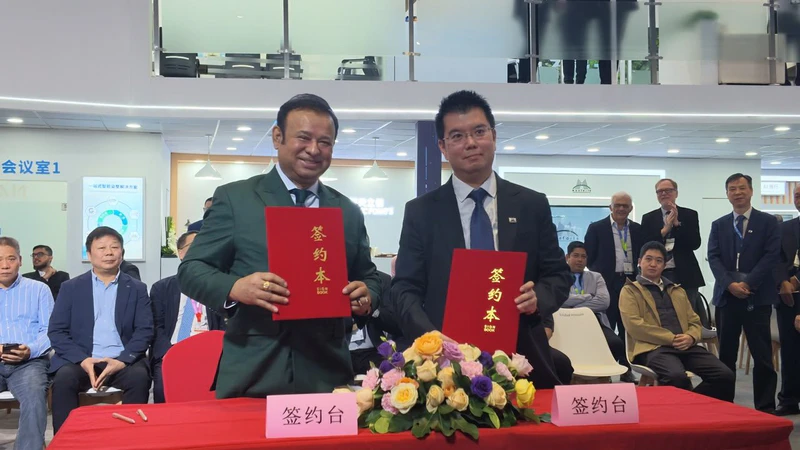
Aswad Composite Mills (Palmal Group) and Fong’s sign the SOFTWIN agreement at ITMA ASIA + CITME 2026. The published announcement names Emdad Hossain, Director-Production of Palmal Group, and Kenneth K.W. Chu, Sales Manager for Bangladesh at Fong’s National Engineering, as attending the signing.
CHTC Fong’s signs dyehouse deals at ITMA ASIA + CITME 2026
CHTC Fong’s signs dyehouse deals at its Shanghai stand: seven mills in China, Bangladesh and Indonesia buy the new SOFTWIN overflow dyeing machine, and Jamuna Denims orders a Goller wet-finishing range
Hong Kong-based dyeing and finishing machinery group CHTC Fong’s used ITMA ASIA + CITME 2026 in Shanghai to launch its SOFTWIN high-temperature overflow dyeing machine and to sign a group of contracts with mills in China, Bangladesh and Indonesia. At a joint signing ceremony on 22 November, the group signed agreements for “intelligent dyehouse” and digital equipment projects with three Chinese companies: Zhejiang Hujiang Thread Industry, Jiangyin Deding Textile and Fujian Xinyuanxin Textile. It also signed equipment agreements with three overseas mills: Jamuna Denims Weaving and Aswad Composite Mills of Bangladesh, and PT KAHATEX of Indonesia.
According to the material published with the Bangladeshi signings, seven factories bought the SOFTWIN machine during the show: four from China, two from Bangladesh and one from Indonesia. Fong’s says the SOFTWIN is newly designed. Fabric tension along the running path is controlled, which it says “can effectively solve color creases and edge curling problems and meet finished-fabric specifications”. The inner plaiter and fabric chamber are designed so that different fabrics run smoothly. The machine offers what the company calls “a larger loading capacity and a low liquor ratio, saving energy and reducing consumption while improving efficiency”, together with simple operation and maintenance.
Aswad Composite Mills belongs to Palmal Group of Industries, a vertically integrated knitwear and apparel group. Palmal says it runs 27 factories in and around Dhaka and makes more than 14 million pieces a month. Emdad Hossain, Director-Production of Palmal Group, signed for Aswad, and Kenneth K.W. Chu, Sales Manager for the Bangladesh market at Fong’s National Engineering Co., Ltd., signed for Fong’s. Jamuna Denims Weaving, the denim mill of Bangladesh’s Jamuna Group, was represented by Bahzad Ahmed, Director of Operations. Jamuna Denims was set up in 2005 and runs high-speed air-jet looms making denim, canvas, chambray and other fabrics.
Besides the dyeing machine, Jamuna Denims has signed for a Goller Multi-Application wet-finishing range. Goller is the German open-width wet-processing brand within the Fong’s group (FONGS Europe GmbH). The range has been designed with the mill as a versatile denim processing line and is scheduled for installation in 2027. The published announcement said it “will significantly enhance both the flexibility and the quality of Jamuna’s denim fabrics during the wet-processing and finishing stages”. Goller’s range covers pre-treatment, washing, caustification and overdyeing of woven and denim fabrics.
Fong’s also signed an agreement with Yantai Yelin Textile Technology to set up a jointly run “dyeing and finishing new R&D equipment experimental base”, where new machines will be tested and refined under real production conditions. Its stand showed three working machines: the ECOWIN high-temperature dyeing machine for synthetic fabrics, the SOFTWIN, and a high-temperature stenter with a coating unit. It also showed models of a dual-circulation spun-oil washing range, the SCN 24 compactor and the XORELLA vacuum yarn-conditioning and heat-setting machine, and gave the first live demonstration of a digital-twin system linked in real time to the machines on the stand.
For the dyehouse equipment market, the Bangladeshi orders are an early sign that the country’s composite mills are still upgrading in the middle of a labour and order crisis at home. Low-liquor-ratio dyeing and integrated wet-finishing lines are among the main ways mills can cut steam, power and chemical use per kilo, and that is increasingly what brands’ environmental requirements are measured against.