
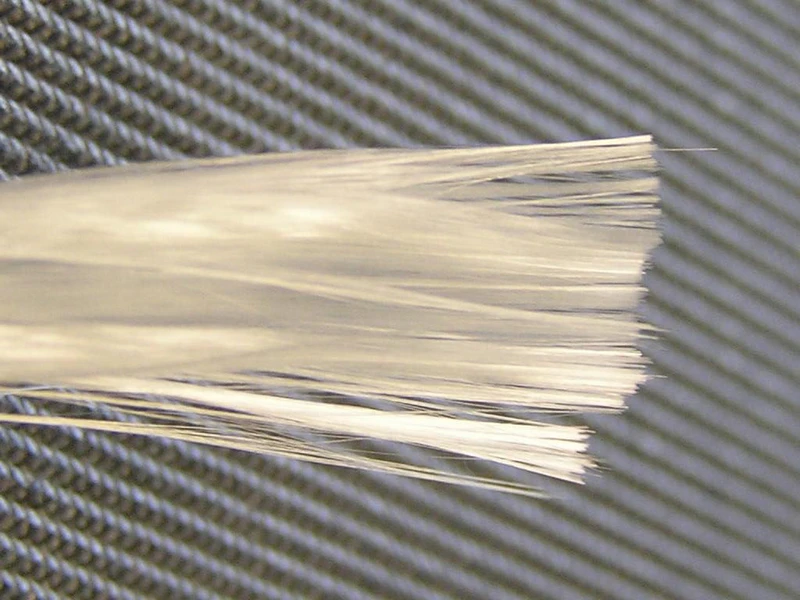
Glass-fibre roving, one of the reinforcement forms (alongside chopped strands and mats) named in the European Commission’s safeguard notice.
EU opens a safeguard investigation into glass-fibre
The European Commission has started a safeguard investigation into imports of “certain composite input materials”. It covers glass-fibre reinforcements, the resins used to make composites, and several chemicals further up the chain. Any measures that follow would apply to imports from every country, not just China. The Commission’s Directorate-General for Trade and Economic Security announced the case in Brussels on 23 November, and the notice of initiation (C/2026/6060) appeared in the Official Journal of the European Union the same day.
The product scope is set out in the notice by Combined Nomenclature (CN) code. The glass-fibre reinforcements covered are chopped strands (CN 7019 11 00), rovings (7019 12 00) and mats (7019 14 00 and 7019 15 00). The resins covered are epoxy resins, their precursor epichlorohydrin and their curing agent isophorone diamine (IPDA), plus unsaturated polyester and vinyl ester resins and their monomer, maleic anhydride. The Commission said it was taking “a supply-chain approach, covering glass-fibre reinforced composites and the chemicals used to make them.”
The import figures in the notice are large. Imports of the materials concerned rose from 697,000 tonnes in 2019 to 898,000 tonnes in 2025, an increase of 29%. Over the same period the imports’ share of the EU market went from 25.9% to 38.2%, and EU producers’ share fell from 74.1% to 61.8%. The Commission puts global overcapacity at about 13.2 million tonnes, which it says “exceeds Union consumption by more than 450 %”. It also warns that trade defence measures in other markets are pushing more material towards Europe. The investigation was opened at the request of Member States.
In its announcement the Commission said: “The surge in imports of these materials into the EU has been driven by growing global overcapacity. It is also prompted by increased use of trade-restrictive measures in other major markets.” It noted that the EU already applies anti-dumping and anti-subsidy duties on glass-fibre reinforcements and epoxy resins from several countries, including China. “These measures cover only those specific products and origins, whereas the safeguard investigation covers a broader range of composite input materials imported from all countries.”
The timetable is tight. Interested parties have 15 days from 23 November to make themselves known, and 21 days to return questionnaires, file written submissions and ask for a hearing. If the conditions are met, provisional measures could follow four or five months after initiation. Definitive measures would then have to follow within 200 days, and no later than nine months (at most eleven) after the investigation began. Safeguard measures also need the support of a qualified majority of Member States.
Industry welcomed the case. Euronews reported that Ludovic Piraux, president of the producers’ association Glass Fibre Europe, said: “The Commission’s decision to launch this investigation confirms the seriousness of the situation facing Europe’s composite input materials industries.” He added: “This case is about safeguarding the industrial capabilities we need to reduce our energy dependencies, strengthen our defence, transform mobility and remain a force in advanced manufacturing.” Euronews also reported that the Commission chose the broader instrument after finding that Chinese producers had been getting around existing duties by moving production to other countries.
For the textile side of the composites business, a lot depends on how the case ends. Rovings, chopped strands and mats are the raw material for woven rovings, multiaxial non-crimp fabrics, stitched mats and the preforms used in wind blades, pipes, boat hulls and transport parts. Fabric converters that weave or stitch imported rovings could face higher input costs, while European glass makers could get relief. Glass-fibre yarns are a separate product. They are not among the CN codes listed and already carry definitive EU anti-dumping duties of 26.3% to 56.1% on Chinese supply, imposed in 2025. Exporters of rovings and resins, wherever they are based, now have a three-week window to take part in a case that could lead to quotas or tariffs on all origins.