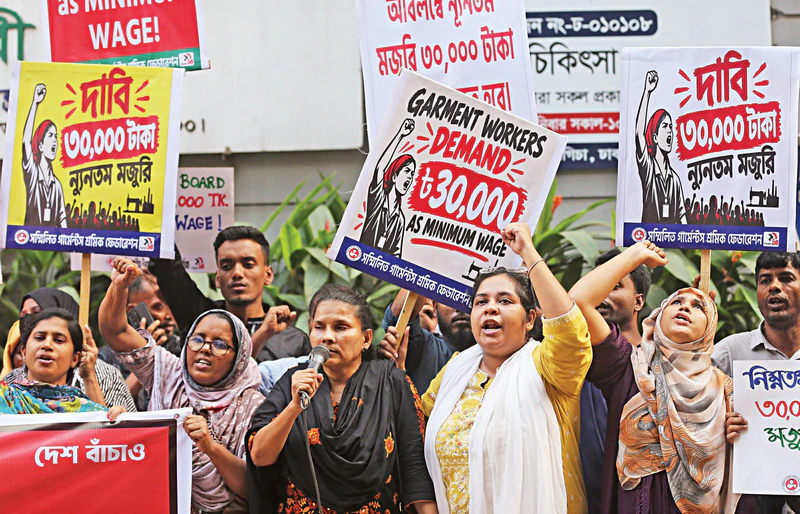
Labour organisations demonstrate in Dhaka for a monthly minimum wage of Tk 30,000 while the garment-sector Minimum Wage Board meets. Photo: The Daily Star.
BGMEA says garment unrest cost US$428 million
The Bangladesh Garment Manufacturers and Exporters Association (BGMEA) has put the first figures on the damage from the labour unrest that has hit the world’s second-largest apparel exporter since early November. In a press release based on a quick survey of its members, the association said 317 garment factories had to stop production between 1 and 18 November, losing output worth US$428 million at FOB value. Buyers had also moved 59 million pieces of confirmed orders, worth about US$254 million, to other countries.
BGMEA said the figures “represented only a partial picture of the actual damage”. More than 600 factories had been affected, but only 317 could answer the short-notice survey, and disruption in the industrial belts was still going on after 18 November. To keep orders, it said, factories have had to use costly air freight and give large price discounts, and some have faced outright cancellations. The association said the shift of confirmed orders to competing countries already showed the damage to buyer confidence. It warned that the crisis threatened “Bangladesh’s long-established reputation, reliability and future prospects in the global apparel market” and called on all stakeholders to help restore normal operations.
Wage negotiations are now in the final stage. At the third meeting of the government-appointed Minimum Wage Board in Dhaka on Monday 23 November, chaired by Syed Azad Subhani, employers put forward their first offer through owners’ representative ABM Shamsuddin. According to people familiar with the talks, quoted by The Financial Express and Prothom Alo, the owners started at Tk 15,000 a month for an entry-level worker, then raised the figure to Tk 15,500 and later to Tk 15,800. Workers’ representatives cut their demand from Tk 32,000 to Tk 25,000 and then to Tk 22,000. The current minimum, set in 2023, is Tk 12,500. BGMEA president Mahmud Hasan Khan attended the meeting as an expert.
The board did not publish the employers’ offer. Its chairman told reporters that “the board unanimously agreed not to reveal the owners’ proposed wage figures yet to avoid confusion, misunderstanding, or tension among stakeholders before discussions conclude,” according to The Financial Express. He added that figures of around Tk 14,300–14,500 circulating in the press were unrealistic and that the outcome would be higher. Workers’ representative Babul Akhter said of the first offer: “The amount is not acceptable.” The meeting ran from late morning until about 8.30 pm and was due to resume at 2.00 pm Dhaka time today, Tuesday (1.30 pm IST). People inside the meeting said a deal could come at that session.
Protests continued while the board met. Prothom Alo reported that authorities in Ashulia, Savar declared 33 factories closed on Monday. Another 22 in the area remained shut under Section 13(1) of the Bangladesh Labour Act, the “no work, no pay” provision. Workers in Sreepur, Gazipur briefly blocked the Dhaka–Mymensingh Highway. Al Jazeera, citing AFP, put the industry’s annual earnings at about US$38 billion and its workforce at around four million. It said about 500 of the country’s more than 4,000 garment factories had been closed during the protests.
For buyers and for competing suppliers, including Indian garment and fabric exporters, two things matter in the coming weeks: what wage the board settles on, and how quickly production returns to normal. A rise of about 26% from Tk 12,500 to around Tk 15,800, or more if the gap closes towards the unions’ Tk 22,000, would feed into FOB prices for the spring–summer 2027 orders being placed now. The US$254 million in orders already moved shows how fast brands can switch volume when lead times are at risk.