Textile Circularity Discussed at WCEF 2026 in Gandhinagar
From Waste Management to a Circular Industrial Economy
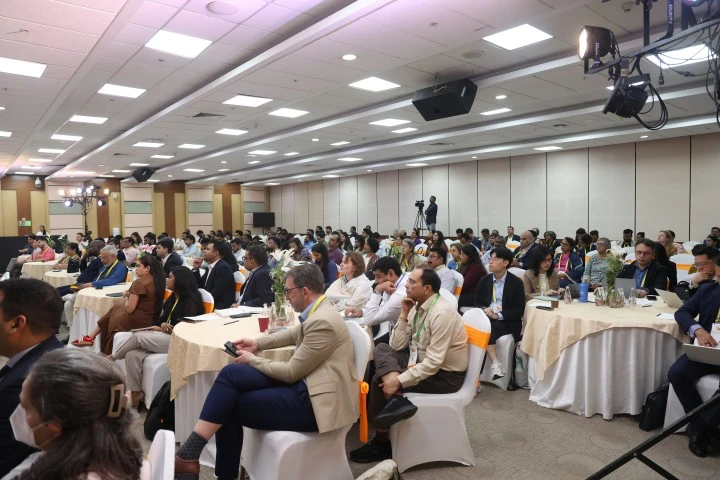
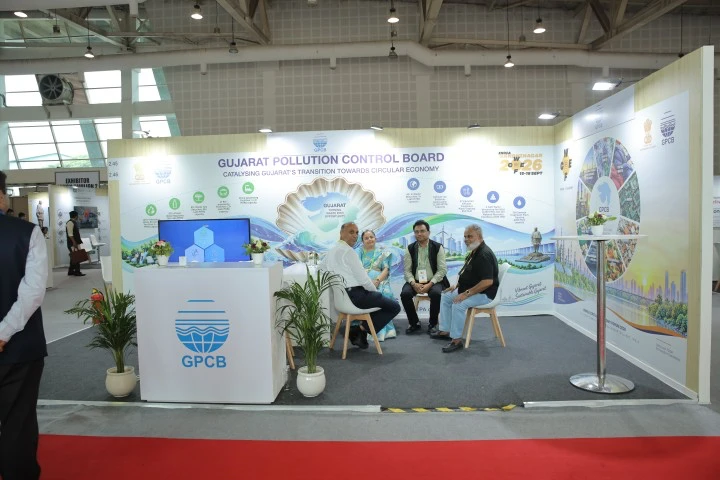
The tenth edition of the World Circular Economy Forum (WCEF2026) brought the global circular-economy conversation to South Asia for the first time when governments, businesses, investors, international agencies, researchers, start-ups and civil-society organisations converged at the Mahatma Mandir Convention and Exhibition Centre in Gandhinagar, Gujarat. The main forum was held on 15–16 September 2026, followed by accelerator sessions on 17–18 September, under the overarching theme “Circular economy: Transition for people and prosperity.” Jointly organised by the Finnish Innovation Fund Sitra and India’s Central Pollution Control Board (CPCB), with support from the Ministry of Environment, Forest and Climate Change, the Governments of India and Finland, the Government of Gujarat and the Gujarat Pollution Control Board, the event placed India — and more broadly the Global South — at the centre of an increasingly urgent debate on how economies can continue to grow while using fewer virgin resources and extracting far greater value from materials already in circulation.
The scale of participation reflected the growing international importance of circularity. According to the organisers and the Government of India, the two-day main forum attracted around 2,700 delegates and 260 speakers representing more than 60 countries, covering governments, international organisations, industry, academia, start-ups and civil society. The accompanying WCEF Expo assembled 135 exhibitors showcasing circular technologies, business models and scalable solutions from India and abroad. After the main programme, 75 accelerator sessions extended the discussions into specialised areas and practical implementation.
The significance of holding the tenth WCEF in India went well beyond geographical symbolism. India is simultaneously one of the world’s fastest-growing large economies, a major manufacturing centre and a rapidly expanding consumer market. Growth on this scale inevitably increases demand for energy, water, minerals, fibres, construction materials and manufactured products. The central proposition running through WCEF2026 was therefore that the circular economy can no longer be viewed simply as a more sophisticated system of waste disposal. It needs to become an industrial, economic and resource-security strategy.
That distinction was repeatedly visible throughout the discussions in Gandhinagar. Instead of asking only how waste could be collected and recycled after products had reached the end of their lives, participants increasingly focused on what happens much earlier: how products are designed, which materials are selected, whether components can be repaired or separated, how secondary materials can compete with virgin materials, how products can remain in use longer, and how finance, regulation, data and technology can make such systems commercially viable.
India’s circular-economy philosophy was strongly articulated at the opening ceremony by Union Environment Minister Bhupender Yadav, who linked contemporary circularity with practices traditionally embedded in Indian society — repairing rather than immediately replacing products, reusing materials rather than discarding them and recovering value before something becomes waste. He emphasised that circularity is intrinsically collaborative because knowledge, technology, finance and responsibility need to move across both borders and sectors. Gujarat Chief Minister Bhupendrabhai Patel, meanwhile, called for practical circular solutions capable of serving not only India but the wider world.
The forum’s dedicated session on India’s Circular Economy Vision pushed this argument further by positioning the country not merely as an adopter of circular-economy models developed elsewhere, but as a potential source of solutions that can be scaled across the Global South. India’s transition was discussed in terms of moving away from the conventional “take-make-dispose” economic model towards resource-efficient manufacturing, circular design, recycling and extended producer responsibility. This combination of traditional resource conservation and modern industrial innovation could become particularly important as emerging economies search for development pathways that do not reproduce the extraordinarily high material consumption levels associated with many mature industrial economies.
One of the clearest messages emerging from Gandhinagar was therefore the need to shift the policy conversation from waste management to resource management. Waste is increasingly being seen as a misplaced resource rather than an unavoidable final output. Metals recovered from discarded electronics, polymers recovered from packaging, fibres recovered from clothing, construction material recovered from buildings and critical minerals recovered from batteries can all become inputs into new production systems.
This shift requires functioning markets for secondary raw materials. Recycled materials need dependable quality specifications, certification, traceability and sufficient volumes if manufacturers are expected to rely on them. Discussions at WCEF highlighted the importance of predictable regulation, effective markets, reliable data and integrated value chains in giving investors sufficient confidence to finance circular businesses. Sitra’s post-event assessment similarly identified these conditions as essential for unlocking investment at scale.
The conversation consequently moved upstream to design. A product that cannot be disassembled economically, that combines materials which are difficult to separate or that uses substances preventing recycling is effectively creating tomorrow’s waste at the moment it is manufactured. Circularity therefore has to begin at the drawing board.
Designing products for durability, repairability, reuse, remanufacture and recycling emerged as one of the recurring foundations of a functioning circular industrial economy. Such an approach changes the role of manufacturers themselves. Instead of maximising the number of products sold and subsequently discarded, future business models could generate value through maintenance, refurbishment, leasing, product-as-a-service arrangements, resale and material recovery.
The governance discussions reflected this broader perspective. The forum examined circular-economy road maps, extended producer responsibility, eco-design regulations, fiscal incentives and digital compliance systems as tools for moving circularity from voluntary initiatives towards mainstream economic practice. Effective governance was presented not simply as environmental regulation but as the framework required to establish viable circular business models and markets for secondary materials.
Another major strand of discussion concerned critical raw materials. The global transition towards renewable energy, electric mobility, digital infrastructure and advanced manufacturing is sharply increasing demand for strategic minerals. Circular approaches can partially relieve pressure on virgin extraction by extending product lifetimes and recovering valuable materials from batteries, electronics, renewable-energy systems and industrial equipment.
WCEF2026 therefore devoted a plenary session to moving “From material dependency to material security.” The argument was straightforward but strategically important: recycling is no longer only an environmental activity. In an era of supply-chain disruptions and competition for strategic resources, the ability to recover and reuse materials increasingly becomes a question of industrial resilience and national economic security.
This perspective has particular relevance for countries in the Global South. In the run-up to the forum, Sitra argued that developing and emerging economies potentially possess trillions of dollars of unrealised economic value if they can move beyond being suppliers of raw materials and instead develop industries that process, manufacture, reuse and recover those resources domestically. The circular economy can consequently become not merely a resource-conservation strategy but also a mechanism for industrialisation, employment and value addition.
Finance consequently occupied an important place in the discussions. Circular projects frequently face difficulties obtaining capital because lenders and investors are accustomed to conventional linear business models. A recycling plant dependent upon uncertain feedstock, a company selling products as a service rather than through conventional ownership, or a business whose value depends upon recovered materials can appear unfamiliar to traditional finance.
The message from Gandhinagar was that circular finance must become mainstream finance. Stable policy, reliable data, transparent material flows and predictable demand for recovered materials can substantially reduce investment risk. Once secondary-resource markets become reliable, circular businesses can increasingly be evaluated on their commercial fundamentals rather than being treated primarily as environmental projects.
Employment provided another important dimension. Circular economies require new capabilities in collection, segregation, repair, refurbishment, remanufacturing, material science, recycling, digital traceability and reverse logistics. At the same time, the transformation can disrupt existing occupations. A dedicated session on the employment potential of the circular economy consequently considered the policies, skills and investment required to ensure that new circular jobs are technologically advanced, economically viable and socially inclusive.
This people-centred dimension distinguished WCEF2026 from a purely technological exhibition. A transition that focuses only on automated recycling plants while ignoring informal workers, small enterprises and local communities would leave a major part of the existing circular economy outside the system. In countries such as India, waste pickers, scrap traders, repair businesses and second-hand markets already keep enormous quantities of material in circulation. Formalising and upgrading these activities while protecting livelihoods is therefore one of the central challenges of India’s circular transition.
The WCEF2026 Expo gave physical form to many of these discussions. Its 135 exhibitors represented the practical side of the transition — demonstrating technologies, services, materials and business models intended to reduce resource consumption, recover materials or keep products and components circulating for longer. The organisers deliberately selected solutions for their scalability and their ability to address leverage points including innovation, policy, finance, business development and skills. Even exhibition practices reflected the philosophy of the event: exhibitors were specifically discouraged from bringing disposable promotional giveaways or other materials likely to become “future waste.”
For the textile and clothing industry, the forum carried especially important messages.
Textiles represent almost every challenge encountered in the circular economy within a single value chain. Fibre production consumes agricultural, petrochemical and other resources; spinning, weaving, knitting, dyeing and finishing consume energy, water and chemicals; garments combine different fibres, finishes, accessories and components; fashion cycles can shorten product lifetimes; and enormous quantities of pre-consumer and post-consumer textile waste remain difficult to recover at high value.
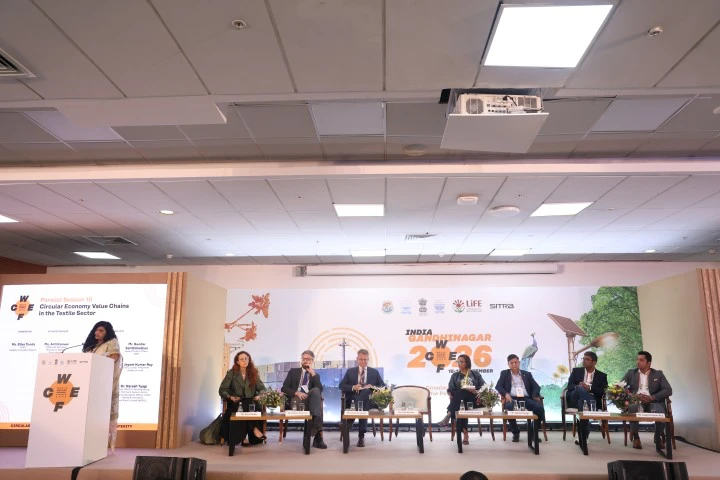
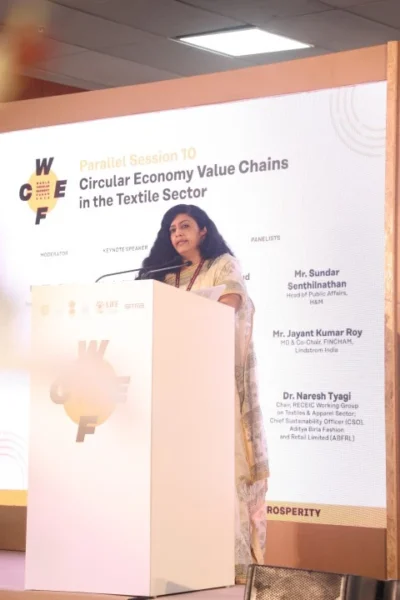
WCEF2026 therefore included a dedicated parallel session entitled “Circular economy value chains in the textile sector.” Organised with the participation of UNEP, the Resource Efficiency and Circular Economy Industry Coalition, GIZ and UNIDO, the discussion examined how circular approaches could transform textile value chains through new policies, financing mechanisms, partnerships and business models. The agenda stretched from sustainable eco-design and regenerative sourcing to automated sorting and closed-loop textile recycling technologies.
That range is significant because true textile circularity requires far more than converting factory cutting waste into lower-value products. A circular textile system ultimately requires garments to be designed for durability and recyclability; fibre compositions and chemical treatments to be identifiable; used textiles to be collected separately; reusable clothing to be channelled towards reuse; recyclable textiles to be automatically sorted according to fibre composition and colour; and recovered fibres to return wherever technically feasible into new yarns, fabrics and garments.
The complexity increases with blended fabrics. Cotton-polyester, elastane-containing materials, coated fabrics, laminates and multicomponent garments are difficult to recycle through conventional mechanical processes. Circular textile development therefore depends on advances in both mechanical and chemical recycling, together with design strategies that minimise unnecessary material combinations.
The Gandhinagar discussions were particularly relevant for India because the country already possesses virtually every part of the textile value chain — fibres, spinning, weaving, knitting, processing, garmenting, textile recycling and large networks dealing in used clothing and production waste. India’s opportunity is therefore not limited to recycling its own textile waste. With the right standards, collection systems, traceability and recycling technology, the country could develop into an important global centre for secondary textile raw materials and fibre-to-fibre recycling.
The main-event textile discussion was reinforced after 16 September through specialised accelerator sessions. One session at Pandit Deendayal Energy University examined integrating post-consumer textiles into circular value chains, concentrating on cooperation among brands, collection networks, logistics providers and recyclers and the development of scalable take-back systems. Another session examined the creation of a circular-fashion ecosystem linking India’s textile clusters, recyclers and brands. A further UNEP-led session at NIFT Gandhinagar examined circular and chemical-safe supply chains in fashion and construction.
Together these discussions signal an important transition for the textile sector. Sustainability is progressively shifting from reducing pollution inside individual factories towards managing the entire product life cycle. Manufacturers will increasingly need to know not only how a fabric was manufactured but also where its fibres originated, which chemicals were used, how long the product can remain in service and what happens to those fibres after the consumer has finished using the product.
Digital technologies could become crucial to making such systems work. Product identifiers, traceability systems and digital records can provide recyclers with information about material composition, chemicals and components. Artificial intelligence and sensor-based sorting systems can improve separation of post-consumer materials, while digital platforms can connect generators of secondary materials with potential industrial users.
The implications extend into international trade. As major markets introduce stronger eco-design, traceability, recycled-content and producer-responsibility requirements, circularity increasingly becomes connected with market access and competitiveness. Exporters capable of demonstrating reliable recycled content, chemical compliance, product traceability and lower material footprints may gain advantages as global buyers restructure supply chains around measurable sustainability criteria.
Gujarat was an appropriate setting for this discussion. As one of India’s major industrial states and a leading centre for textiles, chemicals, petrochemicals, pharmaceuticals, engineering and manufacturing, the state brings together many of the industrial streams that must ultimately be connected if industrial symbiosis is to move from theory to practice. One industry’s by-product can potentially become another industry’s raw material; treated wastewater can substitute freshwater; recovered polymers can return to manufacturing; and industrial clusters can share recycling and resource-recovery infrastructure.
The forum consequently reinforced the importance of moving from isolated recycling projects towards circular industrial ecosystems.
Water circularity is a particularly important opportunity for Indian manufacturing. Rather than withdrawing freshwater, using it once and discharging it, circular industrial systems increasingly recover, treat and reuse wastewater. Gujarat highlighted its experience with wastewater-treatment and reuse infrastructure during the forum, demonstrating how circular-resource principles can be applied not only to solid materials but also to water.
The transition nevertheless faces substantial obstacles. Secondary raw materials frequently struggle to compete with virgin materials on price and consistency. Collection systems remain fragmented. Products are often not designed for disassembly. Recyclers can lack information about material composition. Advanced recycling facilities require large investment and predictable feedstock volumes. Standards differ between countries, creating difficulties for international trade in secondary materials.
These barriers explain why one of the less visible but perhaps most consequential messages emerging from WCEF2026 concerned standards and certification. Circular markets cannot expand rapidly if buyers cannot trust the quality, safety and origin of secondary materials. Internationally recognised specifications for recycled materials could allow these resources to move more freely between industries and countries while reducing perceptions of risk.
At the same time, circularity must avoid becoming an excuse for unrestricted consumption. Recycling alone cannot compensate indefinitely for continually increasing material throughput. The hierarchy remains important: use fewer resources, design products to last, repair them, reuse them, refurbish them and recycle materials when further reuse is no longer practical.
This is one reason WCEF2026 repeatedly connected circularity with prosperity rather than presenting it simply as an environmental sacrifice. Longer-lasting products reduce resource dependence. Repair generates local employment. Recycling retains economic value within an economy. Resource efficiency reduces production costs. Secondary materials can protect manufacturers from volatile commodity markets. Industrial symbiosis can transform disposal costs into material value.
Circularity, in other words, increasingly makes economic sense when systems are designed correctly.
The closing discussions reinforced the need to turn that logic into implementation. Gujarat Minister of State for Environment Pravinbhai Mali emphasised that the real impact would ultimately be measured by collaborations and circular solutions implemented on the ground. Finland’s Minister of Climate and the Environment Sari Multala highlighted inclusion and the human dimension of the transition alongside practical partnerships, business collaboration, innovation and investment.
Another important feature of the Gandhinagar forum was the prominence given to younger entrepreneurs and innovators. A plenary session on youth leadership and circular innovation showcased the role of new enterprises and younger generations in developing circular business models, creating skills and building new markets. This matters because much of the circular economy is unlikely to emerge simply by modifying existing waste-management businesses. New enterprises will be needed in materials science, digital tracking, reverse logistics, sharing platforms, repair technologies, recycling equipment and resource marketplaces.
Recognition was also given to international examples already converting circular principles into practice. The 2026 Circular Awards of the European Union Circular Economy Resource Centre were presented at WCEF, with business awards going to Kenya’s Kijani Testing and Brazil’s Indústria Fox, while the State of Rio de Janeiro received the policy implementation award. The awards provided practical illustrations of circularity emerging from both private enterprise and public policy.
Several new studies and briefings were also associated with the forum, including work examining circular business models in solar value chains. Such work is increasingly important because today’s clean-energy technologies will become tomorrow’s material-recovery challenge. Millions of tonnes of photovoltaic material will eventually reach the end of their first service life; decisions made now regarding product design, maintenance, reuse and recovery will determine whether those assets become waste or valuable sources of secondary materials.
Viewed in this wider context, the Gandhinagar forum represented an important evolution in the circular-economy debate.
The earliest phase of environmental policy concentrated heavily on pollution control.
The next phase focused on waste management and recycling.
WCEF2026 pointed increasingly towards a third phase: circular industrial transformation, in which material efficiency, product design, secondary-resource markets, digital technology, finance and industrial policy become interconnected.
That transition could have profound consequences for manufacturing. Instead of sourcing raw material, manufacturing a product and transferring responsibility to someone else once it is sold, companies increasingly remain connected with the material throughout its life cycle. Producers, retailers, consumers, collectors, recyclers and material processors become parts of the same economic loop.
For India’s textile and clothing sector, this transformation could be particularly consequential. The ability to combine India’s enormous manufacturing base with its established culture of repair and reuse, extensive recycling networks, engineering capabilities and emerging digital infrastructure could create a major new circular-textile industry. But achieving that opportunity will require better segregation of textile waste, systematic post-consumer collection, investment in automated sorting, development of fibre-to-fibre recycling, traceability, eco-design and close cooperation between manufacturers, brands, recyclers and policymakers.
The larger message from WCEF2026 was therefore not that the world needs to become better at managing waste. It was that economies need to design waste out of the system wherever possible and preserve the economic value of materials for as long as possible.
The Gandhinagar gathering brought this argument into the centre of the industrial-development conversation. Circularity was presented not as a niche environmental agenda but as a strategy for resource security, industrial competitiveness, innovation, employment and economic resilience.
With the tenth World Circular Economy Forum concluded, attention now turns from declarations to implementation. The organisers’ post-event assessment distilled the challenge succinctly: investment at meaningful scale requires predictable policies, functioning markets for recovered materials, reliable data and integrated value chains. Those conditions determine whether promising demonstrations remain isolated experiments or become commercially viable industries.
The next World Circular Economy Forum is scheduled to move to New York in June 2027, with Columbia University involved as host. But Gandhinagar has left an important marker in the evolution of the forum. By bringing WCEF to South Asia for the first time, the 2026 edition demonstrated that the future of circularity will not be determined only by the environmental policies of mature economies. It will depend equally — and perhaps increasingly — upon how rapidly major emerging economies such as India can integrate resource efficiency, circular design, secondary materials and recovery systems into their industrial growth.
For India, and particularly for resource-intensive industries such as textiles and clothing, WCEF2026 therefore represented much more than an environmental conference or technology exhibition. It offered a glimpse of a changing industrial economy in which materials cease to be regarded as disposable inputs and instead become productive assets circulating repeatedly through the economy.
That may ultimately prove to be the most important legacy of WCEF2026 in Gandhinagar.

 Textiles represent almost every challenge encountered in the circular economy within a single value chain. Fibre production consumes agricultural, petrochemical and other resources; spinning, weaving, knitting, dyeing and finishing consume energy, water and chemicals; garments combine different fibres, finishes, accessories and components; fashion cycles can shorten product lifetimes; and enormous quantities of pre-consumer and post-consumer textile waste remain difficult to recover at high value.